

It happens to the best of us.
You are in a meeting, or maybe you are chatting with a friend. The conversation is flowing smoothly. You feel confident. Then, suddenly—freeze.
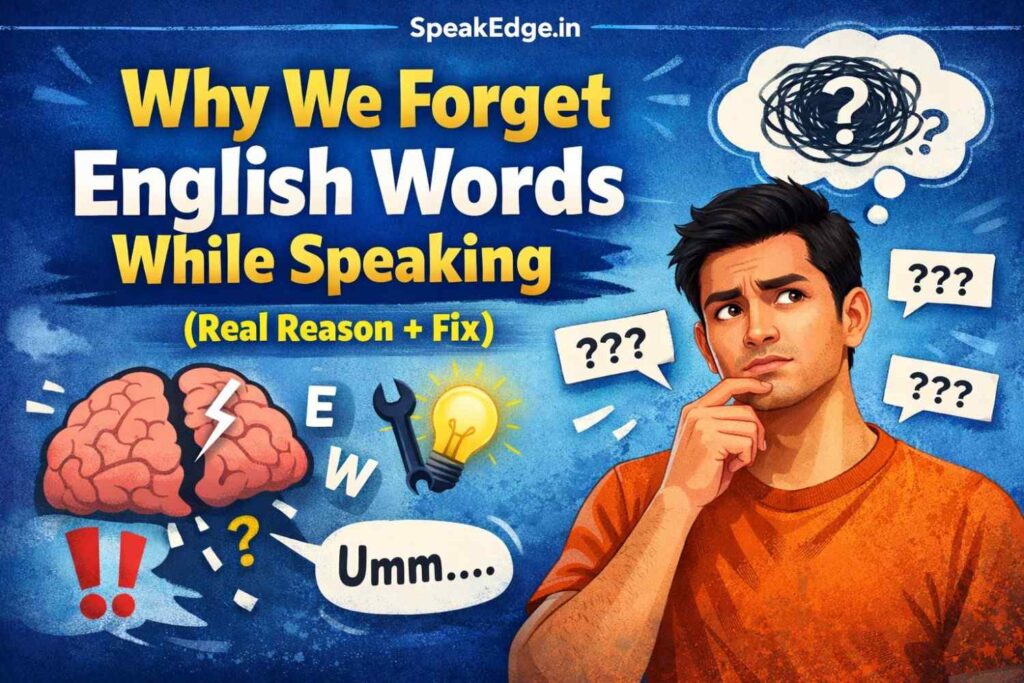
You know exactly what you want to say. You can visualize the object or the concept in your mind. You know that you know the word. You studied it last week! But in this specific moment, your mind is completely blank. The word has vanished.
The silence stretches out. You feel your face getting hot. You stammer, “Uhh… you know… the thing…” Finally, you settle for a simpler, less accurate word, or you stop talking altogether.
Ten minutes later, when the pressure is off and you are walking home, the word pops into your head instantly. “Determine! That was the word! Why couldn’t I say it then?”
This phenomenon is frustrating, embarrassing, and incredibly common. But here is the good news: You do not have a bad memory. You are not “bad at languages.”
There is a scientific and psychological reason why this happens, and once you understand the real mechanics behind it, you can fix it.
In this guide, we are going to dig deep into why your brain hits the “delete” button at the worst possible moments, and I will give you a step-by-step roadmap to stop it from happening.
Part 1: The “Why” – It’s Not About Vocabulary
Most English learners think they forget words because they haven’t studied enough. They think, “I need to memorize more lists. I need to read more dictionary pages.”
This is a misconception.
If you can remember the word when you are calm, but forget it when you are speaking, the problem isn’t storage; the problem is retrieval.
Imagine your brain is a library.
- Storage: The book (the word) is on the shelf. You own it.
- Retrieval: Finding the book quickly when someone asks for it.
When you are speaking, you aren’t just looking for a book; you are looking for a book while running on a treadmill, juggling balls, and answering math questions. Speaking is a high-cognitive task.
Here are the three main culprits that lock the library doors.
1. The “Fight or Flight” Response (Anxiety)
This is the number one reason for forgetting words. When you speak a second language, your brain often perceives the situation as a “threat” to your social status. You are afraid of making a mistake, looking foolish, or being judged.
This mild anxiety triggers a biological response. Your brain releases cortisol (the stress hormone).
Cortisol is great if you need to run away from a tiger. It shuts down non-essential functions to focus on survival. Unfortunately, your brain considers “complex language retrieval” to be a non-essential function. The analytical part of your brain (the Prefrontal Cortex) effectively goes offline.
You aren’t forgetting the word because you don’t know it; you are forgetting it because your brain is too busy panicking.
2. The Passive vs. Active Gap
We have two types of vocabulary:
- Passive Vocabulary: Words you understand when you read or hear them. (This is usually large—maybe 5,000+ words).
- Active Vocabulary: Words you can use instantly in a sentence. (This is usually much smaller—maybe 1,500 words).
The “frozen” moment usually happens when you try to reach for a word that is in your Passive bucket and force it into your Active bucket while under pressure. It’s like trying to lift a heavy weight you haven’t trained for.
3. The “Translation Lag”
If you are still translating from your native language to English (as we discussed in my previous guide), you are adding a massive delay to the process.
You think of the word in your mother tongue. Your brain searches for the English equivalent. If the connection is weak, the search fails. This “404 Error” causes you to panic, which releases more cortisol, which makes it even harder to remember. It is a vicious cycle.
Part 2: The Solution – How to Fix “Brain Freeze”
Now that we know the enemy is usually pressure and weak neural pathways, how do we fix it? We need a two-pronged approach: What to do in the moment when you forget, and what to do at home to prevent it next time.
Strategy A: The “Emergency Kit” (In the Moment)
So, you are in the conversation, and the word is gone. What do you do? Do not panic. Use these three tactics.
1. The “Circumlocution” Technique
This is the fancy term for “talking around the word.” Native speakers do this all the time. If you forget the word “Wallet,” don’t freeze.
Describe it:
- “The small leather thing where I keep my money and cards.”
- “The pocket bank.”
The goal of language is communication, not perfection. If the other person understands you, you have succeeded. Never stop talking just because you miss one word.
2. Use “Filler” Phrases (Correctly)
Silence is awkward. It increases the pressure. Use standard English filler phrases to buy your brain some time to search.
- “What is the word I’m looking for…”
- “It’s on the tip of my tongue…”
- “Let me rephrase that…”
Saying these phrases keeps the conversation “alive” and signals to the listener that you haven’t finished your thought. It takes the pressure off you.
3. The “Synonym Swap”
If you want to say “Exhausted” but can’t remember it, lower your standard immediately.
- Say “Very tired.”
- Say “Sleepy.”
- Say “No energy.”
Don’t let your ego trap you. It is better to use a simple word and keep the rhythm flowing than to hunt for a fancy word and kill the vibe of the conversation.
Strategy B: The “Prevention Plan” (At Home)
To stop this from happening in the future, you need to move words from your Passive Vocabulary to your Active Vocabulary. You cannot do this just by reading. You must produce.
1. The “Recall” Method (Not Recognition)
Most people study by reading a word and its definition. That is Recognition. You need Recall.
- Bad Study: Reading a list of words.
- Good Study: Looking at a picture and forcing yourself to name it.
- Best Study: Flashcards with the definition on the front and the word on the back.
You need to train your brain to produce the word from nothing.
2. The “3-Second Rule”
Take a list of new words you learned this week. Set a timer. Look at the definition. Can you say the word in under 3 seconds?
- If yes: It is in your Active Vocabulary.
- If no: It is still Passive.
Keep practicing until you hit that 3-second mark. Speed is the best indicator of mastery.
3. Contextual Bridges
Our brains remember stories better than data. If you keep forgetting the word “Reluctant” (meaning: unwilling and hesitant), don’t just memorize the definition.
Build a personal bridge.
- “I was reluctant to wake up this morning because it was cold.”
- “My cat is reluctant to take a bath.”
When you attach the word to a real memory or emotion, you create a stronger “hook” in your brain, making it easier to pull out later.
4. Talk to Yourself (The Safe Space)
I mentioned this in the “Thinking in English” guide, but it is vital here too. You need to practice retrieving words when you are not anxious. Describe your room. Describe your job. Describe your dinner. If you forget a word while talking to yourself, look it up immediately. Then say the sentence again five times. This bridges the gap without the social fear.
Part 3: The Psychology of “Good Enough”
Finally, we need to address the root cause of the anxiety: Perfectionism.
Many English learners feel that if they don’t speak like a native, they have failed. They feel that forgetting a word makes them look “stupid.”
Let me tell you a secret: Native speakers forget words too. We call it a “Brain Fart.” We say, “Thingy,” “Whatchamacallit,” or “You know, the stuff.”
When a native speaker forgets a word, they laugh. When a learner forgets a word, they panic.
The difference isn’t linguistic; it’s emotional.
You must give yourself permission to be imperfect. Your listener is not grading you. They are not checking your grammar. They just want to know what you think.
If you forget a word, smile. Take a breath. Describe it. Move on. The more relaxed you are, the better your memory works.
Summary: Your Action Plan
So, the next time you feel that familiar panic rising and a word disappears from your mind, remember this checklist:
- Don’t Panic: Stress kills memory. Take a breath.
- Don’t Stop: Use a filler phrase (“What’s the word…”).
- Describe It: Use “Circumlocution” (The thing that…).
- Simplify: Use a basic synonym (Very big instead of Enormous).
- Review Later: Write down the word you forgot and practice it in a sentence 5 times at home.
Fluency is not about knowing every word in the dictionary. It is about the skill of navigating through the words you do know. Master the art of recovery, and you will never fear silence again.
Frequently Asked Questions (FAQ)
Q: Does reading more help me speak better? A: Reading helps your Passive vocabulary. But to speak better, you must speak. You need to activate the muscles and neural pathways of speech. Reading is input; speaking is output. You need to practice output.
Q: I have been learning for years, why does this still happen? A: It happens because you are likely consuming more English than you are producing. Shift your balance. Spend less time watching videos and more time speaking (even to yourself).
Q: Should I memorize lists of vocabulary? A: Memorizing random lists is inefficient. Learn words that are relevant to your life. If you are a coder, learn coding words. If you are a chef, learn kitchen words. Context is King.
Q: Is it okay to use Google Translate in the middle of a conversation? A: Try to avoid it. It breaks the flow and connection with the listener. Only use it as a last resort if you absolutely cannot explain the concept otherwise.





Discussion