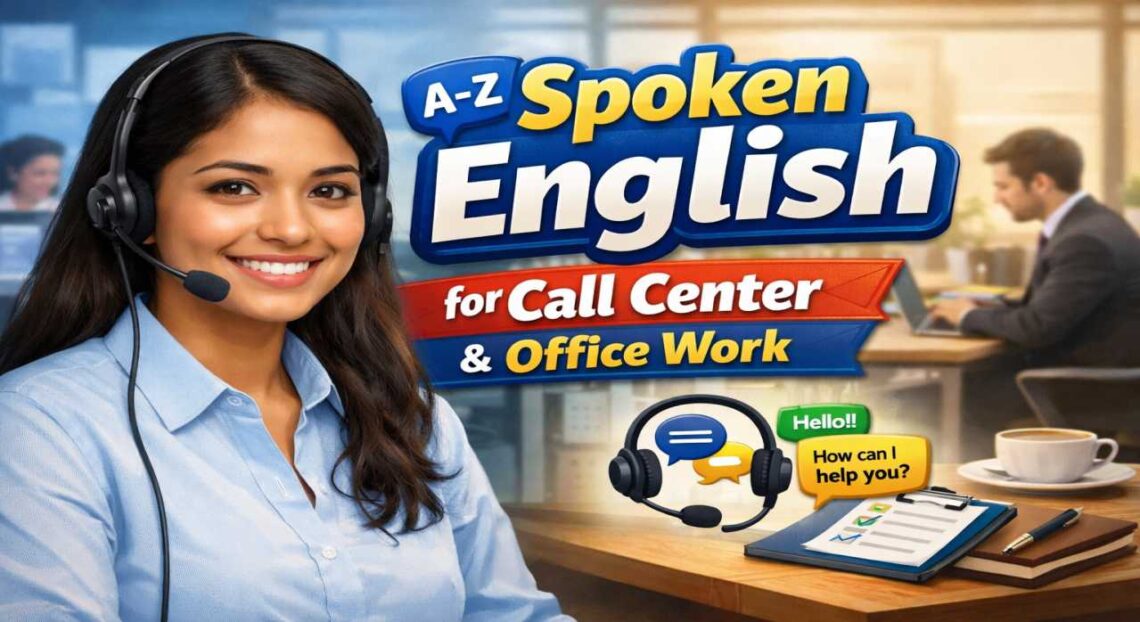
The Ultimate Guide to Spoken English for Call Centers and Office Work: From Nervous to Native
In the modern professional world, English is no longer just a language—it is a global currency. Whether you are answering a customer’s frustrated call in a high-pressure BPO environment or presenting a quarterly report in a corporate boardroom, the way you speak defines your professional identity.
However, many job seekers and employees face a common barrier: the “Fluency Gap.” You might know the grammar rules, but when the phone rings or the boss looks at you, the words vanish.
If you’ve ever felt this way, don’t worry. This guide will walk you through everything you need to know about mastering professional spoken English, specifically tailored for the Indian corporate and BPO landscape.
Part 1: The Foundation of Professional Communication
Before we get into specific scripts and phrases, we must understand that “Professional English” is different from “Academic English.” In school, we learn to pass exams; in the office, we speak to get results.
1.1 Clarity vs. Accent
One of the biggest myths in the call center industry is that you need a “fake” American or British accent. This is false. Modern international clients value neutrality and clarity above all else.
- Neutrality: Avoiding heavy regional influences.
- Clarity: Pronouncing consonants clearly and not rushing your sentences.
1.2 The Power of Tone
In a call center, your tone is your body language. Since the customer cannot see your smile, they must “hear” it. A “smiling voice” is achieved by actually smiling while you speak—it physically changes the shape of your mouth and makes your tone warmer.
1.3 Active Listening: The Half-Brother of Speaking
You cannot speak well if you don’t listen well. In an office setting, “Active Listening” means giving verbal cues like “I see,” “Right,” or “Correct” to show you are engaged.
If you find that your mind goes blank because you’re overthinking the grammar, you should read our guide on how to think in English to stop the internal translation process.
Part 2: Spoken English for Call Centers (BPO/ITES)
The BPO industry is the gateway for many young professionals. Here, communication follows a specific lifecycle: The Call Flow.
2.1 The Opening (The First Impression)
The first 10 seconds determine the customer’s mood.
- Standard Script: “Thank you for calling [Company], my name is Suman. How can I help you today?”
- Pro Tip: Use a falling intonation at the end of “today” to sound authoritative yet helpful.
2.2 Probing and Discovery
You need to find out the problem without sounding like a police officer.
- Instead of: “Tell me your problem.”
- Use: “Could you please walk me through what happened?” or “To better assist you, may I ask a few questions regarding your service?”
2.3 Empathy: The Secret Sauce
Empathy is not sympathy. You don’t have to feel sorry for them; you just have to acknowledge their situation.
- Phrase 1: “I realize how important this is to you.”
- Phrase 2: “I can certainly understand why that would be frustrating.”
- Phrase 3: “Thank you for bringing this to our attention; let’s get this fixed for you.”
2.4 Hold and Transfer Etiquette
This is where most agents lose points. Never “cold transfer” a call.
- The Request: “May I place you on a hold for two minutes while I consult with my supervisor?”
- The Return: “Thank you for staying on the line. I have an update for you.”
2.5 Closing the Call
Always leave the door open for future help.
- Closing: “It was a pleasure assisting you today. Is there anything else I can help you with? Thank you for choosing [Company], have a wonderful day!”
Part 3: Spoken English for Office and Corporate Work
Office English is less scripted than call center English. It requires more flexibility and diplomacy.
3.1 Navigating Meetings
Meetings are where your visibility is highest. If you sit silently, you become invisible.
- Sharing an Opinion: “In my experience…” or “From my perspective, we should consider…”
- Agreeing with Style: “I’m on the same page as Rahul regarding the timeline.”
- Disagreeing Diplomatically: “I see your point, however, I’m concerned about the budget.”
3.2 Small Talk: The Watercooler Conversations
In an office, building relationships is key. This happens through small talk.
- “How was your weekend?”
- “Have you seen the latest project update?”
- “Are you planning to attend the team dinner?”
3.3 Handling Feedback
When a boss gives you feedback, your English should show growth, not defensiveness.
- Professional Response: “I appreciate the feedback. I will make sure to incorporate these changes in the next draft.”
Part 4: Common Mistakes and How to Fix Them
4.1 The “Translation” Trap
Most people think in Bengali or Hindi and then translate to English. This causes “mother tongue influence” (MTI) and slow speech.
- The Fix: Start describing your daily routine in English to yourself.
4.2 Filler Words
Using “umm,” “uhh,” and “actually” too much makes you sound unsure.
- The Fix: It is better to be silent for two seconds than to say “umm.” Silence sounds like you are thinking; filler words sound like you are struggling.
Are you struggling with vocabulary? Check out our article on why we forget English words while speaking and how to build a mental library.
Part 5: 7-Day Action Plan for Fluency
If you want to be ready for a job interview in a week, follow this:
- Day 1: Audit. Record yourself speaking for 2 minutes and listen to your mistakes.
- Day 2: Shadowing. Watch a business news channel (like CNBC or BBC World) and repeat what the anchor says.
- Day 3: Mirror Practice. Practice your “Self Introduction” in front of the mirror focusing on eye contact.
- Day 4: Vocabulary Expansion. Learn 10 “Power Verbs” for the office (e.g., Collaborate, Implement, Streamline).
- Day 5: Mock Calls. Roleplay a difficult customer call with a friend.
- Day 6: Reading Aloud. Read a blog post on SpeakEdge.in out loud to improve your mouth muscles.
- Day 7: Real-world Test. Call a customer care center of any brand and try to resolve a small query in English.
Part 6: Vocabulary Cheat Sheet for the Office
| Word / Phrase | Professional Usage (Example Sentence) |
| Streamline | “We need to streamline the reporting process to save time.” |
| Leverage | “Let’s leverage our social media presence to increase sales.” |
| Escalate | “If the customer isn’t satisfied, I will escalate the ticket to my lead.” |
| Touch Base | “Let’s touch base on this project next Monday afternoon.” |
| Bandwidth | “I’m sorry, I don’t have the bandwidth to take on a new task today.” |
| Circle Back | “I don’t have that data right now, but let’s circle back to it later.” |
| Bottleneck | “The slow approval process is creating a bottleneck for the team.” |
| Collaborate | “I’d love to collaborate with the marketing team on this campaign.” |
| Deliverables | “What are the key deliverables for the client by the end of this week?” |
| Discrepancy | “There is a slight discrepancy between the two sets of figures.” |
| Empower | “Our goal is to empower the customers to solve issues using the app.” |
| Feasible | “Is it feasible to finish this website migration by Friday?” |
| Feedback | “I would appreciate your feedback on the new UI design.” |
| Framework | “We are developing a new framework for our customer support.” |
| Go the extra mile | “Our team is always willing to go the extra mile for client satisfaction.” |
| In the loop | “Please keep me in the loop regarding any changes to the schedule.” |
| Incentive | “The company is offering an incentive for the top-performing agents.” |
| KPI | “Our primary KPI this month is to reduce the average handling time.” |
| Mitigate | “We need to find a way to mitigate the risks involved in this project.” |
| Onboard | “It will take us about three days to onboard the new interns.” |
| Outsource | “We might need to outsource the graphic design work this month.” |
| Paradigm Shift | “The move to remote work has been a major paradigm shift for us.” |
| Proactive | “We need to be proactive in identifying potential server issues.” |
| Quorum | “We can’t start the voting process until we have a quorum in the room.” |
| Redundant | “Some of these manual entries are redundant and should be automated.” |
| Stakeholder | “We need to present this plan to all the stakeholders for approval.” |
| Synergy | “There is a great synergy between our sales and support departments.” |
| Take Ownership | “I will take ownership of this issue and see it through to the end.” |
| Update | “Could you please provide a quick update on the billing status?” |
| Workaround | “The system is down, but I found a workaround to process the order.” |
Conclusion: Your Journey Starts Today
Mastering spoken English for the workplace is a marathon, not a sprint. The key is consistency. By using the scripts provided and practicing the techniques mentioned, you will notice a significant shift in your confidence.
Remember, every expert was once a beginner. If you are just starting your journey, I highly recommend reading our English speaking guide for beginners to ensure your basics are rock solid.
What is your biggest fear when speaking English at work? Is it the fear of making a mistake or not finding the right word? Let’s discuss in the comments!

Suman
I am the creator of SpeakEdge, a learning-focused blog dedicated to English speaking, career guidance, and self-improvement. My goal is to help students, job seekers, and beginners improve their communication skills, gain confidence, and make better career decisions through simple, practical, and easy-to-understand content. I believe learning should be clear, honest, and useful in real life—not confusing or overwhelming.





One Comment
Pingback: