
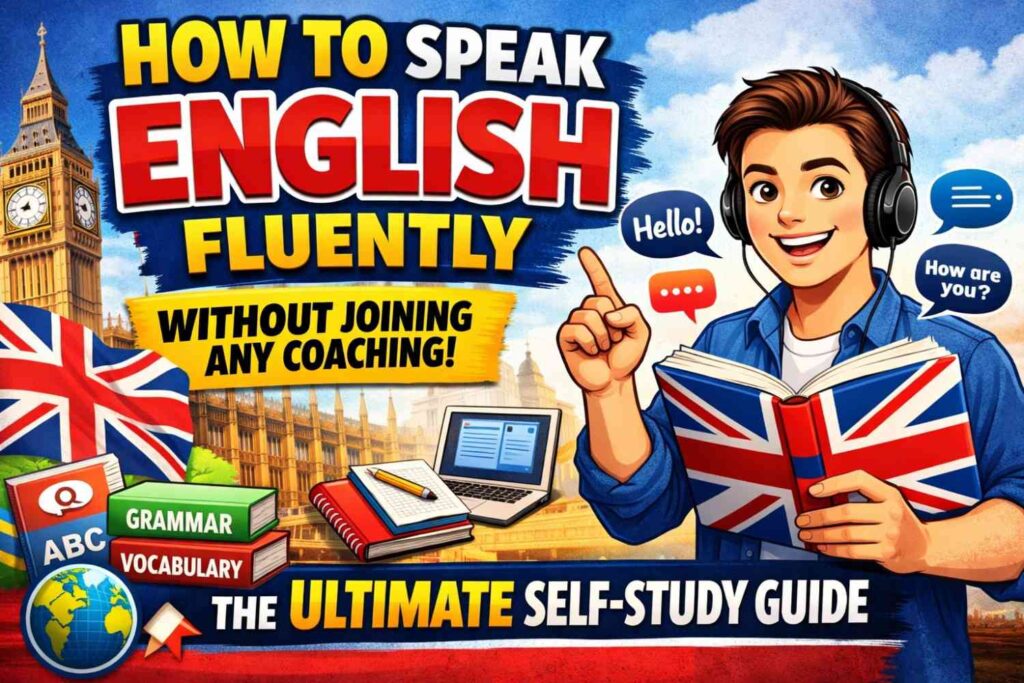
How to Speak English Fluently Without Joining Any Coaching: The Ultimate Self-Study Guide
Introduction: Why You Don’t Need a Classroom to Conquer English
Let’s be honest for a second. When you think about learning to speak English fluently, what’s the first image that pops into your head?
Is it a boring classroom with a dusty chalkboard? Is it a strict teacher correcting your grammar every five seconds? Or maybe it’s the hefty price tag of a coaching center that promises “fluency in 30 days” (which we all know is a myth)?
If you’ve been holding back from improving your English because you don’t have the time or money for coaching, I have some incredible news for you: You don’t need it.
In fact, some of the most fluent English speakers in the world never stepped foot inside an English coaching center. They learned by living the language, not just studying it. They learned through movies, through mistakes, and through sheer curiosity.
In this guide, I am going to walk you through the exact, step-by-step roadmap to go from “nervous beginner” to “confident speaker” entirely on your own. We will cover the psychology of fluency, the daily habits you need, and the free (and cheap) tools that are better than any expensive tutor.
Ready to find your voice? Let’s dive in.
Part 1: The Mindset Shift – Why “Studying” Fails and “Acquiring” Works
Before we talk about how to speak, we need to fix how you think about English.
Most people treat English like a subject—like History or Math. They memorize rules, take tests, and try to get everything perfect. The problem? Language isn’t a subject; it’s a skill. It’s like swimming or riding a bike. You can’t learn to swim by reading a book about water physics; you have to get wet.
The “Baby Method”
Think about how a baby learns their mother tongue. Do they study grammar books? No.
- They Listen: For months, they just absorb sounds.
- They Imitate: They try to say words (and fail).
- They Speak (Badly): They say “baba” instead of “bottle.”
- They Get Corrected (Gently): Parents guide them, and they improve.
To learn English without coaching, you must adopt this mindset. You are not “studying” English anymore; you are acquiring it.
Part 2: The 4-Pillar Strategy for Self-Taught Fluency
To replace a coaching center, you need a system. A coaching center provides structure. Since you are going solo, you need to build your own structure. We call this the 4-Pillar Strategy.
Pillar 1: Aggressive Listening (Input)
You cannot speak what you have not heard. If you want to speak natural, modern English, you need to flood your brain with it.
- Podcasts: This is your best friend. Listen to podcasts while you commute, cook, or clean. (Recommendation: The English We Speak by BBC or All Ears English).
- YouTube: Forget grammar tutorials. Watch content you actually enjoy—tech reviews, vlogs, cooking shows—but in English.
- Audiobooks: Listening to a story helps you understand the rhythm of the language.
Pro Tip: Don’t just listen passively. Use “Active Listening.” When you hear a new phrase, pause the audio and write it down.
Pillar 2: The Imitation Technique (Shadowing)
This is the single most powerful technique for self-learners. It’s called Shadowing.
How to do it:
- Find a video of a native speaker (TED Talks are great for this) with subtitles.
- Play the video.
- As the speaker talks, you repeat exactly what they say, at the same time or just a split second after them.
- Mimic their speed, their emotion, and their pauses.
This trains your mouth muscles to move in the “English way.” It feels weird at first, but it works like magic for pronunciation.
Pillar 3: Thinking in English
The biggest barrier to fluency is translation.
- You hear English.
- You translate it to your native language.
- You formulate a reply in your native language.
- You translate it back to English.
- You speak.
This process is too slow. You need to cut out the middleman. Start small:
- Naming Objects: Look around the room. Don’t think “Kitaab” (or your native word), think “Book.”
- Narrating Your Day: As you walk to the bus, say in your head: “I am walking to the bus stop. It is a bit sunny today. I hope the bus is on time.”
Pillar 4: Speaking to No One (The Mirror Method)
You don’t need a partner to practice speaking. Stand in front of a mirror and talk to yourself for 5 minutes every day. Pick a topic (e.g., “My favorite movie”) and just talk. Watch your mouth move. Make eye contact with yourself.
This builds confidence because there is no one there to judge you.
Part 3: Daily Routine for the Busy Person
“I don’t have time” is the oldest excuse in the book. You don’t need 2 hours a day. You need 20 focused minutes. Here is a sample schedule optimized for working professionals or students.
| Time of Day | Activity | Duration | Goal |
| Morning (Commute/Breakfast) | Listen to a Podcast | 15 Mins | Passive Input (Ear training) |
| Lunch Break | Read one news article aloud | 5 Mins | Pronunciation & Vocabulary |
| Evening (Relaxing) | Watch 1 Episode of a Sitcom | 20 Mins | Slang & Cultural context |
| Before Bed | “Journaling” (Speak your day) | 5 Mins | Active Output (Fluency) |
Total Time: 45 Minutes (mostly integrated into your life).
Part 4: Leveraging Technology (Affiliate & Tool Section)
This is where you can supercharge your learning. While you don’t need expensive coaching, a few smart tools can speed up the process.
1. AI Language Partners (The Future is Here)
If you are shy about speaking to real humans, start with AI. ChatGPT (Voice Mode) or Google Gemini are incredible, free conversation partners. You can literally say, “Hey, pretend you are a waiter and I am a customer. Let’s practice ordering food.” They will roleplay with you endlessly without judgment.
2. Best Apps for Vocabulary
- Duolingo: Good for absolute beginners to keep a streak habit.
- Anki: The best app for “Spaced Repetition.” If you learn a new word, put it in Anki. It will remind you of the word right before you are about to forget it.
3. Speaking Platforms (If you want to spend a little)
(Affiliate Opportunity: Insert links to Cambly, iTalki, or Preply here) Eventually, you will want to speak to real humans. Platforms like Cambly or iTalki connect you with native speakers for as little as $5-$10. It’s not “coaching”—it’s just conversation. You aren’t paying for a lesson; you are paying for practice time.
Recommendation: If you are serious about fast results, try booking just one 30-minute session a week purely for conversation practice.
Part 5: The “Content Consumption” Strategy (Movies & TV)
Watching movies is fun, but are you learning from them? Here is the right way to watch Netflix for English:
- Choose the Right Content: Don’t pick Inception or Sherlock (too complex/fast). Pick a sitcom like Friends, The Office, or Modern Family. The language is everyday, repetitive, and visual.
- The Subtitle Rule:
- Beginner: English Audio + Native Subtitles.
- Intermediate: English Audio + English Subtitles.
- Advanced: No Subtitles.
- The “Pause and Mimic” Rule: If a character says a cool phrase (e.g., “I’m gonna grab some coffee”), pause it. Repeat it. Write it down.
Part 6: Overcoming the Fear of Grammar
Here is a secret that coaching centers won’t tell you: Native speakers make grammar mistakes all the time.
They say “Me and him went out” instead of “He and I went out.” They use slang. They cut sentences short.
If you obsess over grammar, you will become a Stuttering Scholar. You will know all the rules but be unable to speak a sentence. If you focus on communication, you will become a Confident Speaker. You might make mistakes, but people will understand you. And understanding is the goal of language.
Rule of Thumb:
- Writing requires accuracy. (Emails, Resumes).
- Speaking requires flow. (Conversation). Don’t let the fear of “Is it in, on, or at?” stop you from opening your mouth.
Part 7: How to Monetize Your English Journey (Bonus for Readers)
Wait, why is this section here? Because learning English opens doors—financial doors.
As you improve your English without coaching, you are developing a skill that is highly monetizable.
- Freelancing: English opens up the global freelance market on Upwork and Fiverr.
- Content Creation: You can document your journey! Start a blog (like this one) or a YouTube channel sharing “How I am learning English alone.” People love relatable stories.
- Affiliate Marketing: As you find books or apps that help you, share them with others using affiliate links.
English isn’t just a language; it’s an income multiplier.
Part 8: Common Obstacles and How to Smash Them
Obstacle 1: “I have no one to practice with.”
- Solution: Talk to yourself, talk to your pet, or use the “Voice Typing” feature on Google Docs. Dictate a story. If Google understands you, your pronunciation is good!
Obstacle 2: “I get stuck and can’t find the word.”
- Solution: Learn “filler words” and “circumlocution.”
- Filler words: “Well…”, “You know…”, “Let me think…” (These buy you time).
- Circumlocution: If you forget the word for “Umbrella,” describe it: “The thing we use when it rains to stay dry.”
Obstacle 3: “People laugh at my accent.”
- Solution: Your accent is a sign of bravery. It means you speak more than one language. Own it. Aim for clarity, not a British or American accent. If you are clear, you are fluent.
Conclusion: Your Journey Starts Today
Learning English without coaching is not only possible; it is often better. It forces you to take responsibility. It allows you to learn topics you actually care about. It saves you thousands of dollars.
The road to fluency isn’t a straight line. You will have days where you feel like a poet, and days where you can’t remember the word for “chair.” That is normal. The only way you fail is if you stop.
So, cancel that expensive inquiry to the coaching center. Put on your headphones. Open your mouth. Start speaking. The world is waiting to hear what you have to say.
FAQs (Frequently Asked Questions)
Q1: Can I really become fluent without living in an English-speaking country? A: Absolutely. Most English speakers in Europe and Asia learned it in their home countries through internet immersion. You create your own “English environment” at home.
Q2: How long will it take? A: If you practice consistently for 30-45 minutes a day, you will see a massive improvement in 3 months and likely reach conversational fluency in 6-12 months.
Q3: Which book is best for self-study? A: Word Power Made Easy by Norman Lewis is a classic for vocabulary. For reading pleasure, start with Atomic Habits—the language is simple and practical. (Link to book)
Q4: Is grammar not important at all? A: It is important, but it should not be the first priority. Learn grammar through context (listening/reading), not through memorizing rules.
(Did you find this guide helpful? Share it with a friend who is struggling with English! And don’t forget to subscribe to our newsletter for weekly tips on productivity and self-improvement.)

Suman
I am the creator of SpeakEdge, a learning-focused blog dedicated to English speaking, career guidance, and self-improvement. My goal is to help students, job seekers, and beginners improve their communication skills, gain confidence, and make better career decisions through simple, practical, and easy-to-understand content. I believe learning should be clear, honest, and useful in real life—not confusing or overwhelming.