
How to Speak English Fluently for Beginners: Your Ultimate Step-by-Step Guide to Unlocking Confidence
Let’s be honest. There is nothing more frustrating than having a head full of English vocabulary and grammar rules, but freezing up the moment you need to open your mouth and speak.
You know the words. You understand what others are saying. But when it’s your turn, the words get stuck in your throat. Your heart races, you stutter, and you revert to your native language in defeat.
If this sounds familiar, I want you to know something important: You are not broken, and you are not bad at languages. You have simply been focusing on the wrong things.
Traditional education taught you how to read and write English. It rarely teaches you how to speak it.
Fluency isn’t about knowing every word in the dictionary or having perfect grammar. Fluency is about flow. It’s the ability to express your thoughts easily and articulate them without causing strain on yourself or the listener.
If you are a beginner, or an “eternal intermediate” learner ready to finally break through the speaking barrier, this guide is for you. We are going to move away from dusty textbooks and focus on practical, actionable steps that change how your brain processes language.
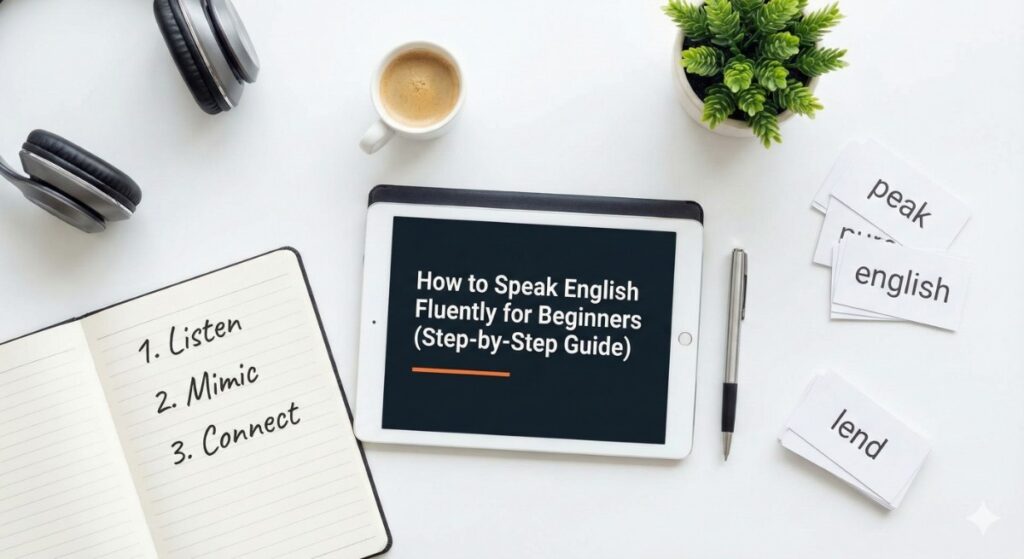
Grab a cup of coffee (like the one in our cover image), put on your headphones, open your notebook, and let’s begin your journey to English fluency.
The Fluency Mindset: Before You Speak a Word
Before we dive into the “how-to,” we must address the biggest obstacle standing between you and fluency: Perfectionism.
Beginners often believe they must construct a perfect sentence in their head before they say it out loud. This is the “fluency killer.” By the time you have grammatically checked your sentence mentally, the conversation has moved on.
The Golden Rule of Speaking: Communication is more important than perfection.
Makes mistakes. Make lots of them. Every time you make a mistake and someone corrects you (or you correct yourself), your brain builds a stronger pathway for the correct version. Embrace the messy process of learning. You have to speak “bad” English before you can speak “good” English.
The Roadmap: A 3-Step Framework for Beginners
As outlined in the notebook in our image, the journey to speaking fluently for beginners can be broken down into three essential phases. You cannot skip any of them.
1. Listen (The Foundation) 2. Mimic (The Bridge) 3. Connect (The Goal)
Let’s explore exactly how to execute each stage.
STEP 1: LISTEN (Build Your Foundation)
You cannot speak what you haven’t heard. It sounds obvious, but most beginners try to output (speak) before they have had enough input (listening).
Think about how babies learn their first language. They don’t start with grammar books. They listen for a year or two, absorbing the sounds, rhythms, and intonation patterns of their parents.
To speak fluently, you need to flood your brain with English sounds.
1. Active vs. Passive Listening
- Passive Listening: Having English radio on while you clean the house. This is better than nothing, but it won’t make you fluent. It gets your ears used to the “noise” of English.
- Active Listening: This is where the magic happens. This involves listening with full intention, trying to understand not just the words, but the emotion and the structure behind them.
2. The “Comprehensible Input” Strategy
Start listening to material that is just slightly above your current level. If you understand 10% of a CNN news broadcast, it’s useless noise. If you understand 100% of a children’s book, you aren’t growing.
Aim for material where you understand about 70-80%. This allows your brain to use context clues to figure out the rest, which is a crucial skill for fluency.
Actionable Tools for Listening:
- Podcasts for Learners: Look for podcasts specifically designed for beginners/intermediates. They often speak slower and explain difficult vocabulary. (e.g., 6 Minute English by BBC, VOA Learning English).
- YouTube with a Twist: Watch videos on topics you already love (cooking, gaming, coding) in English. Turn on subtitles in English, not your native language. Your goal is to connect the sound you hear with the written word you see.
- Netflix “Binge-Learning”: Watch a show you have already seen in your native language, but watch it again in English. Since you already know the plot, you can focus entirely on how they express those ideas in English.
STEP 2: MIMIC (The Bridge to Speaking)
This is the most neglected step in language learning, yet it is the most critical for moving from understanding to speaking.
Listening puts English into your head. Speaking requires getting it out of your mouth. There is a physical disconnect between your brain knowing a word and your tongue muscles being able to produce it smoothly in a sentence.
Your mouth muscles are currently trained for your native language. You need to retrain them for the acrobatics of English pronunciation.
The Technique that Changes Everything: Shadowing
If you only do one thing from this entire guide, do this.
Shadowing is a technique where you listen to a piece of audio and repeat exactly what you hear, almost simultaneously (about a half-second delay). You are “like a shadow” following the speaker.
How to do it correctly:
- Choose short audio: Find a 2-minute clip of audio with a transcript (a podcast snippet or a YouTube video). Ensure the speaker has an accent you like.
- Listen first: Listen to the clip once to understand the meaning.
- Listen and Read: Listen again while reading the transcript to connect sounds to spelling.
- The Shadow: Play the audio. As soon as the speaker starts, you start mimicking them out loud.
- Crucial Point: Do not just repeat the words. Copy their emotion. Copy their pauses. Copy when their voice goes up at the end of a question and down at the end of a statement. You are acting.
- Record and Compare: Record yourself shadowing a short section. Play it back alongside the original. You will instantly hear where your pronunciation or rhythm is different.
Focus on “Chunks,” Not Isolated Words
Fluent speakers don’t speak word-by-word. They speak in “chunks” or collocations—groups of words that naturally go together.
- Beginner approach: translating “How… are… you… doing… today?” robotically.
- Fluent approach: Saying “Howyadoin today?” as one smooth unit.
When you mimic, focus on how words blend together. Look at the flashcards in our image—don’t just write single words like “English” or “Lend.” Write whole phrases: “Can you lend me a hand?” or “I’m learning English.” Learning in chunks is a shortcut to fluency because your brain doesn’t have to assemble sentences from scratch every time.
STEP 3: CONNECT (The Ultimate Goal)
You have listened, and you have trained your mouth muscles through mimicking. Now it’s time for the scariest part: real interaction.
The goal of English is connection. You cannot become fluent in a vacuum. You need the pressure and unpredictable nature of a real conversation to cement your skills.
1. The “Safety Net” Phase: Speaking to Yourself
Before you face the world, practice in private.
- Narrate Your Life: As you go about your day, describe what you are doing in simple English. “I am walking into the kitchen. I am pouring water into the coffee machine. The water is hot.” It sounds silly, but it trains your brain to retrieve English vocabulary instantly based on your surroundings.
- The Shower Speeches: Have debates with yourself in the shower. Talk about your plans for the weekend. No one is listening, so the pressure is off.
2. Stop Thinking in Your Native Language
Translating in your head is the biggest barrier to fluency. It takes too long.
When you look at the plant on your desk, don’t think of the word in your language and then translate it to “plant.” Train yourself to look at the object and immediately think the English word.
Exercise: Set an alarm five times a day. When it goes off, look around the room and name every object you see only in English for 60 seconds.
3. Finding Speaking Partners (Low Pressure)
You don’t need to jump into a high-stakes business meeting. You need low-pressure environments to practice connecting.
- Language Exchange Apps: Apps like HelloTalk or Tandem connect you with people who want to learn your language, and in exchange, they help you with English. It’s free, and everyone there is a learner, so they understand the struggle.
- Online Tutors (iTalki/Preply): If you have a small budget, hiring a community tutor for just conversation practice is incredibly valuable. You are paying them to be patient and correct you. It’s a safe space to make mistakes.
- Voice Notes over Text: If real-time calling is too scary, start by sending voice notes on WhatsApp or Telegram to English-speaking friends. This gives you time to compose your thoughts before hitting send.
The Tools of the Trade (Leveraging Technology)
Looking back at our flat-lay image, we see a tablet, headphones, and flashcards. Let’s look at how to use these effectively.
1. The Tablet/Smartphone (Your Portable Classroom) Don’t just use it for social media. Turn it into an English immersion device. Change your phone’s language settings to English. Siri or Google Assistant can also be great practice partners—if they can understand you, your pronunciation is getting better!
2. Headphones (Your Bubble of Immersion) Use noise-canceling headphones to create an English bubble. When you are commuting or washing dishes, you should be listening. This constant drip-feed of English is essential for the “Listen” step.
3. Flashcards (Done Right) Digital flashcard apps like Anki are superior to paper because they use Spaced Repetition Systems (SRS). The app knows when you are about to forget a word and shows it to you right before you do.
- Pro-Tip: Never put just the word on the card. Put the word in a full sentence, preferably with an image. Context is king for memory.
Your 30-Day “Fluency Starter” Routine
Knowing how is useless without knowing when. Beginners often fail because they rely on motivation instead of routine. Motivation fades; routine sticks.
You do not need 3 hours a day. You need 30 minutes of focused consistency.
Here is a sample plan to kickstart your fluency journey over the next month:
Daily Routine (Approx. 30-45 mins):
- Morning (15 mins – Input): Listen to an English podcast designed for learners while getting ready or commuting. (Step 1: Listen).
- Afternoon/Lunch Break (10 mins – Practice): Do a 10-minute session on a flashcard app (Anki) reviewing whole phrases.
- Evening (20 mins – Output):
- Pick a 2-minute segment of audio you listened to in the morning.
- Spend 10 minutes “Shadowing” it intently. (Step 2: Mimic).
- Spend the last 10 minutes narrating what you did that day out loud to yourself while cooking or winding down. (Step 3: Connect).
Weekly Add-on:
- Weekend (60 mins): Schedule one 45-60 minute conversation with a language exchange partner or tutor.
If you stick to this modest routine for 30 days, you will not be fluent, but you will be significantly more confident. You will notice words coming faster, and the fear of speaking will begin to shrink.
Conclusion: Trust the Process
Learning to speak English fluently is a marathon, not a sprint. There will be days when you feel like you are making no progress. There will be days when your tongue feels tied in knots.
That is normal. Keep showing up.
Don’t compare your Chapter 1 to someone else’s Chapter 20. Focus on the steps in your notebook: Listen intently, mimic shamelessly, and connect courageously.
The world is waiting to hear what you have to say. So, put on those headphones, take a deep breath, and start speaking. You’ve got this.
FAQs: Common Beginner Doubts
Q: How long does it take to become fluent in English? A: It depends on your starting point and daily dedication. However, with consistent, active practice (like the routine above), most beginners can reach a conversational level (B1/B2) where they feel comfortable traveling and handling daily interactions within 6 to 12 months. True, deep fluency takes years of ongoing practice.
Q: My accent is terrible. Should I worry about it? A: No. An accent is a sign of bravery—it means you are speaking a second language. Your goal is clear pronunciation, not eliminating your native accent. If people can understand you easily, your accent is fine. Focus on intonation and rhythm (through shadowing) rather than individual sounds.
Q: What if I don’t have anyone to practice English with? A: That is no longer a valid excuse in the internet age! Use language exchange apps (Tandem, HelloTalk), join English learner Discord servers, or use AI tools. Even talking to yourself consistently is better than waiting for the “perfect” partner.
Q: Is grammar important for speaking fluently? A: Yes, but don’t obsess over textbook rules before you speak. You need basic grammar frames to construct sentences, but you will learn more complex grammar through listening and mimicking naturally, just like a child does. Focus on communicating the message first; refine the grammar later.

Suman
I am the creator of SpeakEdge, a learning-focused blog dedicated to English speaking, career guidance, and self-improvement. My goal is to help students, job seekers, and beginners improve their communication skills, gain confidence, and make better career decisions through simple, practical, and easy-to-understand content. I believe learning should be clear, honest, and useful in real life—not confusing or overwhelming.




One Comment
Pingback: