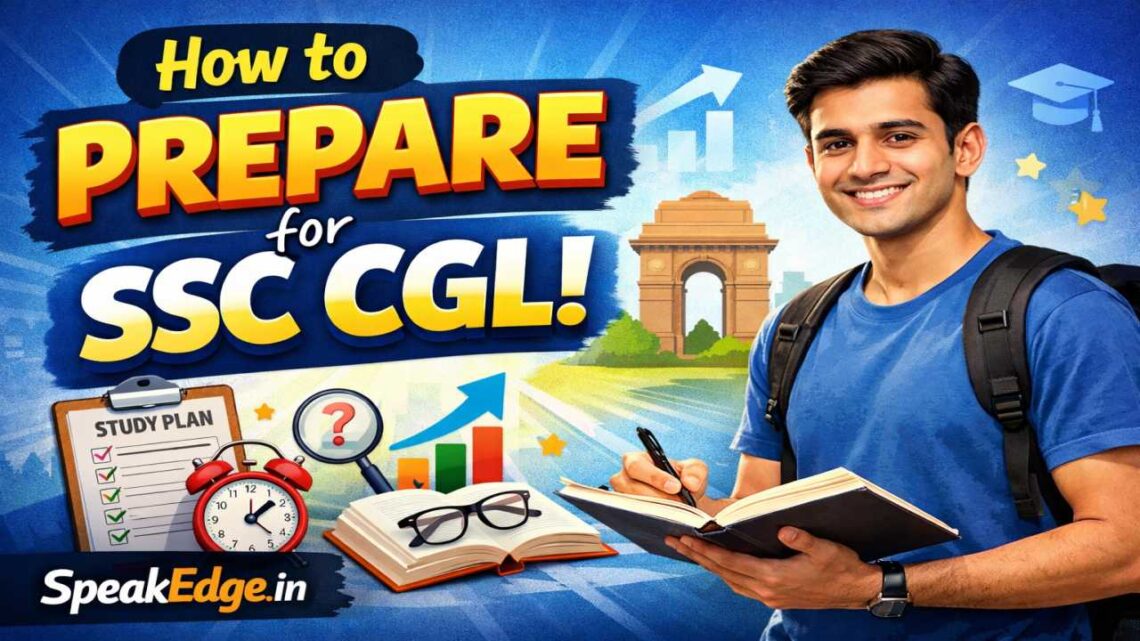
How to Prepare for SSC CGL 2026: The Ultimate Guide to Eligibility, Salary, and Strategy
The SSC CGL (Staff Selection Commission – Combined Graduate Level) is often referred to as the “Mini-IAS” of India. It is one of the most sought-after competitive exams, offering a gateway to prestigious Group B and Group C government posts. Whether you dream of becoming an Income Tax Inspector, an Assistant Section Officer (ASO) in the Central Secretariat, or a CBI Sub-Inspector, the journey starts here.
In this exhaustive guide, we will break down the 2026 eligibility criteria, the latest salary structure, and a battle-tested preparation strategy to help you crack the exam on your first attempt.
1. SSC CGL Eligibility Criteria 2026: Can You Apply?
Before investing months into preparation, you must ensure you meet the official requirements. The Staff Selection Commission is strict about these three pillars:
A. Nationality
You must be a citizen of India, a subject of Nepal/Bhutan, or a Tibetan refugee who settled in India before January 1, 1962.
B. Age Limit (As of January 2026)
The age requirement varies by post. Generally:
- 18–27 years: For Auditor, Accountant, and Tax Assistant.
- 18–30 years: For Inspector (Excise/Income Tax) and ASO posts.
- Up to 32 years: Specifically for the Junior Statistical Officer (JSO).
Note: Relaxation of 3 years for OBC and 5 years for SC/ST candidates applies as per government norms.
C. Educational Qualification
- All General Posts: A Bachelor’s Degree in any stream from a recognized university.
- JSO: Bachelor’s Degree with at least 60% in Mathematics at the 12th-grade level or a degree with Statistics as a core subject.
2. SSC CGL Salary Structure: More Than Just a Paycheck
The salary is based on the 7th Pay Commission and is divided into different Pay Levels. Here is what your monthly take-home might look like in 2026:
| Pay Level | Basic Pay | Starting Gross (Approx. in X-Cities) | Key Posts |
| Level 8 | ₹47,600 | ₹85,000+ | AAO (Audit/Accounts) |
| Level 7 | ₹44,900 | ₹80,000+ | Income Tax Inspector, ASO, Excise |
| Level 6 | ₹35,400 | ₹65,000+ | Divisional Accountant, SI (NIA) |
| Level 5 | ₹29,200 | ₹55,000+ | Auditor, Accountant |
| Level 4 | ₹25,500 | ₹48,000+ | Tax Assistant, UDC |
Perks & Benefits: Beyond the salary, you receive HRA (House Rent Allowance), DA (Dearness Allowance), and Transport Allowance. More importantly, the job provides immense security, medical facilities under CGHS, and a respected social standing.
3. The New Exam Pattern: Tier 1 and Tier 2
The SSC has streamlined the process into two major computer-based tiers.
Tier 1 (Qualifying)
This is a 60-minute test consisting of 100 questions (2 marks each). It covers:
- Reasoning: 25 Questions
- General Awareness: 25 Questions
- Quantitative Aptitude: 25 Questions
- English: 25 Questions
Tier 2 (Merit Maker)
This is where the real battle happens. It includes Mathematical Abilities, Reasoning, English Language, and General Awareness. Data Entry Speed Test (DEST) and Computer Knowledge are also mandatory qualifying modules.
4. Section-Wise Preparation Strategy
A. Quantitative Aptitude (The Game Changer)
Maths is often the most feared section. Divide your prep into two parts:
- Arithmetic: Focus on Percentage, Profit & Loss, and Ratio. These are the foundations.
- Advance Maths: Geometry, Algebra, and Trigonometry carry huge weight in Tier 2.
- Tip: Don’t just learn formulas; understand the derivation to solve “tricky” questions.
B. English Language & Comprehension
English carries the highest weightage in Tier 2 (45 questions). Many students struggle here because they focus only on grammar and ignore vocabulary and reading.
Pro Tip: To master the English section, you need a mix of grammar rules and daily reading habits. For a deep dive into improving your communication and grammar for competitive exams, check out our dedicated guide on Speakedge.in. It’s an excellent resource for Hindi-medium students looking to bridge the gap in their English scores.
C. General Intelligence & Reasoning
This is the most scoring section. Practice daily to improve your logic. Focus on:
- Series Completion
- Blood Relations
- Syllogism
- Non-verbal reasoning (images)
D. General Awareness (The Time Saver)
You can finish 25 questions in 5-7 minutes.
- Static GK: Geography, History, and Indian Constitution.
- Current Affairs: Follow the last 8-12 months of news before the exam date.
5. The 6-Month Master Plan
- Months 1-3 (Foundation): Complete the syllabus. Don’t touch mock tests yet. Focus on clearing concepts for every chapter.
- Month 4 (Previous Year Questions): Solve the last 5 years of SSC CGL papers. SSC often repeats patterns. Use books like Kiran or Pinnacle.
- Month 5 (Sectional Mocks): Identify your weak areas. If your Geometry is weak, spend an entire week solving only Geometry questions.
- Month 6 (Full-Length Mocks): Take one mock test every day. Analyze the results for 2 hours. Identify why you missed a question—was it a calculation error or a conceptual gap?
6. Common Mistakes to Avoid
- Ignoring the Computer Module: Many candidates score high in Maths but fail the qualifying Computer test. Don’t let that be you.
- Over-reliance on Short Tricks: Tricks fail when the question is slightly twisted. Always learn the basic method first.
- Skipping Newspaper Reading: Reading improves your “reading speed,” which is crucial for the long passages in Tier 2 English.
Final Thoughts
Cracking SSC CGL 2026 requires more than just hard work; it requires a strategy that adapts to the changing competition. Stay consistent, keep your resources limited but revise them multiple times, and remember that every mock test you take brings you one step closer to that Inspector’s desk.
Frequently Asked Questions (FAQs)
Q1. What is the minimum educational qualification for SSC CGL?
The basic requirement is a Bachelor’s Degree in any discipline from a recognized university. However, for specialized posts like Junior Statistical Officer (JSO), you need a degree with a background in Mathematics or Statistics.
Q2. Is there any limit on the number of attempts for SSC CGL?
No, there is no limit on the number of attempts for the SSC CGL exam. You can apply as long as you meet the age criteria specified for the respective posts.
Q3. Is the SSC CGL Tier 1 exam marks added to the final merit?
No. As per the latest exam pattern, Tier 1 is qualifying in nature. This means you only need to clear the cutoff to move to Tier 2. Your final selection and post allotment will be based solely on your Tier 2 performance.
Q4. How can I improve my English score for the Tier 2 exam?
English carries the highest weightage in Tier 2 (45 questions). Success here depends on a solid grasp of grammar and a rich vocabulary. For a detailed roadmap on how to tackle these concepts, including tips for Hindi-medium students, check out this guide on how to master English for competitive exams over at Speakedge.in.
Q5. What are the best books for SSC CGL Quant preparation?
For beginners, R.S. Aggarwal is great for basics. For advanced practice and previous year questions (PYQs), most toppers recommend Kiran Publication or Pinnacle books to understand the specific question patterns used by the SSC.
Q6. Is there a physical test for all SSC CGL posts?
No, physical standards and tests are only mandatory for specific “Uniform Posts” like Inspector (Central Excise/Preventive Officer/Examiner) and Sub-Inspector in CBI or NIA. Desk jobs like Assistant Section Officer (ASO) or Auditor do not require a physical test.
Conclusion: Take the First Step Today
The road to a central government job is paved with consistent effort. By understanding the eligibility and aiming for the impressive salary packages we discussed, you already have the “Why.” Now, use the strategy above to build your “How.”

Suman
I am the creator of SpeakEdge, a learning-focused blog dedicated to English speaking, career guidance, and self-improvement. My goal is to help students, job seekers, and beginners improve their communication skills, gain confidence, and make better career decisions through simple, practical, and easy-to-understand content. I believe learning should be clear, honest, and useful in real life—not confusing or overwhelming.