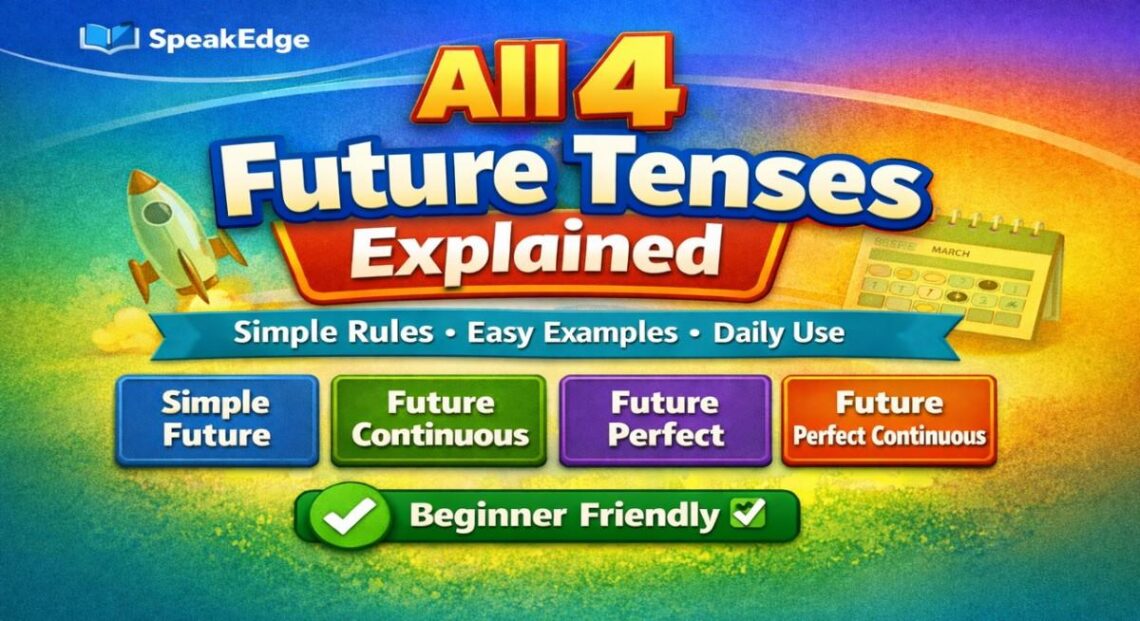
The Ultimate Guide to the 4 Future Tenses (Predicting Tomorrow)
We spend a lot of time thinking about the future. “What will I eat for dinner?” “Where am I going to go on vacation?”
In English, we don’t just have one way to talk about the future. We have four. And believe it or not, the difference between “I will call you” and “I will be calling you” can completely change the meaning of your sentence.
Whether you are making a promise, a plan, or a prediction, choosing the right tense is the secret to sounding confident.
In this guide, we are completing our grammar journey by breaking down the 4 Types of Future Tense. Let’s dive in!
1. Simple Future Tense
“The Prediction & Promise Tense”
This is the most flexible tense. We use it for instant decisions, predictions without hard evidence, and promises. Note: You can also use “going to” for planned events, but for this guide, we will focus on the classic “will”.
When to use it:
- Instant Decisions: You decide something right now (“I’ll take the red one”).
- Predictions: What you think will happen (“It will rain tomorrow”).
- Promises & Offers: “I will help you with your homework.”
The Formula:
Subject + will + Base Verb
Real-Life Examples:
- I will call you later. (A promise).
- I think Brazil will win the World Cup. (A prediction/opinion).
- Wait, I will open the door for you. (Instant decision).
- She will not (won’t) come to the party. (Negative).
2. Future Continuous Tense
“The ‘Do Not Disturb’ Tense”
Imagine a specific moment in the future. What will be happening at that exact moment? This tense describes an action that will be in progress. It suggests that if you call me at that time, I will be busy doing something.
When to use it:
- Actions in progress at a future time: “At 8 PM, I will be eating.”
- Polite inquiries: Asking about someone’s plans (“Will you be using the car?”).
- Routine future events: Things that happen naturally.
The Formula:
Subject + will be + Verb(-ing)
Real-Life Examples:
- Don’t call me at 9 AM. I will be sleeping. (The action will be happening then).
- This time next week, we will be flying to Paris. (In the middle of the journey).
- Will you be staying for dinner? (Polite question).
- He will be working all weekend.
3. Future Perfect Tense
“The Deadline Tense”
This tense is a favorite for project managers and students. It looks back from the future. It tells us that an action will be finished before a specific time in the future.
When to use it:
- Deadlines: Stating that something will be done by a certain time.
- Accomplishments: “By age 30, I will have bought a house.”
The Formula:
Subject + will have + Past Participle (V3)
Real-Life Examples:
- By 5 PM, I will have finished this report. (The work will be over).
- Call me after 8. The movie will have ended by then.
- By next year, they will have been married for 50 years.
- I will have saved enough money by December.
4. Future Perfect Continuous Tense
“The Anniversary Tense”
This is the rarest of the four, but it makes you sound very advanced. It emphasizes duration up to a point in the future. We often use it to celebrate milestones or emphasize how long something has been going on.
When to use it:
- Duration at a future date: “In April, I will have been working here for 10 years.”
- Cause and effect in the future: “He will be tired because he will have been driving for 6 hours.”
The Formula:
Subject + will have been + Verb(-ing)
Real-Life Examples:
- By next month, I will have been learning English for two years. (Focus on the duration).
- When she retires, she will have been teaching for 40 years.
- By the time you arrive, we will have been waiting for an hour!
Comparison Table: The “Travel” Example
Let’s see how the meaning changes when we talk about travel.
| Tense | Sentence | Meaning |
| Simple Future | I will travel to Japan. | I just decided/I promise to go. |
| Future Continuous | I will be traveling to Japan. | I will be on the plane at that specific time. |
| Future Perfect | I will have traveled to Japan. | The trip will be finished by that future date. |
| Future Perf. Cont. | I will have been traveling for 10 hours. | Emphasizes how long the journey takes. |
Conclusion
Congratulations! If you have read our previous posts on Present and Past tenses, you have now completed the entire English Tense system.
The Future Tense gives you the power to dream, plan, and set goals. Start simple with “will,” and as you get more confident, try using “will have been” to talk about your future achievements.
Which tense will you practice today? Let us know in the comments!

Suman
I am the creator of SpeakEdge, a learning-focused blog dedicated to English speaking, career guidance, and self-improvement. My goal is to help students, job seekers, and beginners improve their communication skills, gain confidence, and make better career decisions through simple, practical, and easy-to-understand content. I believe learning should be clear, honest, and useful in real life—not confusing or overwhelming.