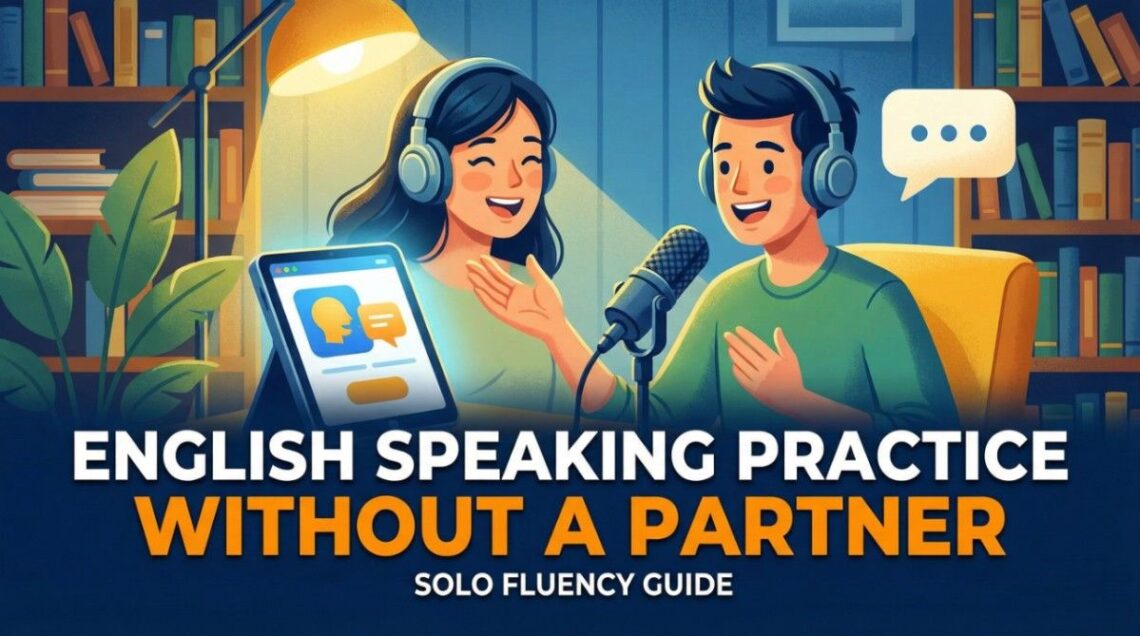
How to Master English Speaking Practice Without a Partner: The Ultimate Solo Guide
Category: Education / Language Learning Reading Time: ~12 Minutes
Let’s be honest for a second. The number one advice you hear when trying to learn English is: “You need to find a speaking partner.”
They tell you to find a native speaker, join a club, or pay for expensive tutors. And sure, that’s great advice—in a perfect world. But in the real world? Maybe you’re shy. Maybe you don’t have the budget for daily classes. Or maybe you just live in an area where nobody speaks English.
Does that mean you’re stuck? Absolutely not.
I am here to tell you a secret: Some of the most fluent English speakers in the world taught themselves to speak alone in their bedrooms.
You do not need a partner to become fluent. You need a system. In this guide, we are going to break down exactly how to practice English speaking without a partner, using techniques that actually work. No fluff, just actionable steps to take you from “hesitant” to “confident.”

Why Solo Practice Might Actually Be Better
Before we dive into the how, let’s look at the why. Practicing alone isn’t just a backup plan; it has distinct advantages over practicing with a partner.
- Zero Anxiety: When you are alone, you can’t be embarrassed. You can make the weirdest sounds, mess up your grammar, and stutter without fear of judgment. This psychological safety allows you to experiment more freely.
- Repetition: You can repeat the same sentence 50 times until it sounds perfect. Try doing that with a conversation partner—they will get bored. You won’t.
- Your Pace, Your Schedule: You don’t need to coordinate time zones. 2:00 AM? Practice time. 10 minutes on the bus? Practice time.
Phase 1: The “Input” Techniques (Imitation)
You cannot output (speak) what you haven’t input (heard). Solo practice starts with active listening.
1. The Shadowing Technique (The Holy Grail)
If you only take one thing away from this post, let it be Shadowing. This is the closest you can get to a real conversation without another human.
How to do it:
- Step 1: Find a video or podcast with a native speaker. (TED Talks or YouTube vlogs are perfect because they use natural, modern English).
- Step 2: Listen to a sentence.
- Step 3: Pause the audio.
- Step 4: Repeat exactly what they said.
The Pro Level (Simultaneous Shadowing): Once you are comfortable, don’t pause. Try to speak along with the speaker, just a split second behind them. Mimic their speed, their emotion, and their pauses. This forces your mouth to move at a native pace.
2. Movie Mimicry
Pick a favorite character from a movie or series (like Friends or Suits). When they deliver a cool line, pause and say it. Try to “act” it out. Adopting a persona can actually trick your brain into feeling more confident. If you are pretending to be Harvey Specter, you’ll speak with more authority than if you are just “practicing grammar.”
Phase 2: The “Output” Techniques (Production)
Now that you have warmed up your ears, it’s time to use your voice. This is where most people get stuck because they feel silly talking to themselves. Get over that feeling—it’s the key to fluency.
3. Narrate Your Life (The Commentary Track)
Imagine you are a YouTuber vlogging your life, but the camera is off. Narrate everything you are doing in real-time.
- “Okay, I am opening the fridge. I need to find the milk. Ah, there it is, but there is only a little bit left. I should probably buy more tomorrow.”
Why this works: It connects English vocabulary to physical actions. You aren’t translating from your native language; you are associating the action of opening a fridge directly with the English phrase.
4. The “Mirror Method”
Stand in front of a mirror. Look yourself in the eye. Pick a topic for the day—politics, your favorite football team, or what you ate for lunch—and talk for two minutes.
Watching your own mouth move helps you correct pronunciation. Plus, maintaining eye contact with yourself builds the confidence you’ll need when looking at a real person later.
5. Jam Sessions (The Shower Speech)
The shower is the best place to practice English. Why? Because the acoustics are great and you are relaxed. Have arguments with imaginary people. Replay a conversation you had earlier but say what you wish you had said in English. Explain a complex concept to an imaginary audience.
Phase 3: Using Technology as Your Partner
We live in the golden age of AI. You don’t need a human partner because you have digital ones that never sleep and never judge.
6. Voice Typing (Dictation)
Open Google Docs or the Notes app on your phone and turn on “Voice Typing.” Try to write a paragraph just by speaking.
If Google understands you and writes the correct words, your pronunciation is clear. If it writes “sheep” when you said “ship,” you know exactly what you need to fix. This is instant feedback without a teacher.
7. AI Conversations (ChatGPT / Gemini)
This is a game-changer. Most AI tools now have a voice feature.
- Open the app.
- Say: “I want to practice my English. Can we roleplay? You are a waiter, and I am a customer ordering food. Correct my mistakes after every response.”
- Talk to the AI.
The AI will wait patiently, understand your accent better than most humans, and give you corrections only when you ask for them.
8. Recording Yourself
This is painful, but necessary. Record yourself reading a paragraph or speaking freely on your phone. Then, listen to it.
- Do you sound like a robot?
- Did you stumble on the “th” sound?
- Is your intonation flat?
You will be your own harshest critic. Keep the recording and do it again a week later. Comparing the two is the best motivation you will ever find.
Phase 4: Rewiring Your Brain
Speaking isn’t just about mouth movement; it’s about processing speed. The biggest barrier to speaking fluently is translation.
9. Stop Translating, Start Thinking
If you think in your native language and then translate to English, you will always be slow and choppy. You need to cut out the middleman.
The Drill:
- Level 1 (Nouns): Look around the room. Don’t think the word in your native language. Look at a table and instantly think “Table.” Look at a shoe and think “Shoe.”
- Level 2 (Sentences): When you see a bus, don’t think “The bus is coming” in your language. Think: “The bus is arriving.”
- Level 3 (Abstract): When you are feeling happy or sad, try to articulate why in English inside your head.
10. The Tongue Twister Challenge
Tongue twisters are not just for kids. They are gym workouts for your mouth muscles. English requires different mouth shapes than Hindi, Spanish, or Bengali.
- “She sells seashells by the seashore.”
- “Red lorry, yellow lorry.”
Do these for 5 minutes a day to loosen up your jaw and improve diction.
A 7-Day Solo Practice Routine
To make this SEO-friendly and actionable, here is a structured plan you can follow. Bookmark this page so you can come back to it.
- Monday: Shadowing. Spend 15 minutes mimicking a TED Talk.
- Tuesday: Narration. Describe your cooking or driving process for 20 minutes.
- Wednesday: AI Roleplay. Talk to ChatGPT for 15 minutes about a recent movie.
- Thursday: The Mirror. Talk to yourself for 5 minutes about your future goals.
- Friday: Singing. Find a fast English song (Ed Sheeran or Eminem) and try to keep up with the lyrics.
- Saturday: Recording. Record a 1-minute diary entry. Listen and critique.
- Sunday: Rest & Review. Watch an English movie without subtitles.
Common Obstacles (and How to Fix Them)
“I run out of things to say.”
Solution: Use prompts. Search online for “IELTS speaking topics” or “conversation starters.” Pick one at random, set a timer for 1 minute, and force yourself to speak until the timer goes off.
“I don’t know if I’m making mistakes.”
Solution: Use tools like Grammarly or AI. Speak your sentence into a dictation app, copy the text, and paste it into a grammar checker. It will show you if you messed up the tense or preposition.
“I feel stupid talking to myself.”
Solution: Put on headphones. If people see you walking down the street with headphones on, moving your lips, they will just assume you are on a phone call. It’s the perfect disguise for public practice.
Conclusion: Consistency is Key
Learning to speak English without a partner is not only possible; it is a powerful way to build self-reliance. You don’t need a plane ticket to the US or UK. You don’t need a native friend. You just need curiosity and the discipline to open your mouth and speak, even when no one is listening.
Start today. Look away from this screen, look at the nearest object, and describe it out loud. Congratulations—you just started your journey to fluency.
FAQs
Q: How long does it take to become fluent by practicing alone? A: It depends on your current level, but with consistent daily practice (30-60 minutes), most learners see a significant boost in confidence within 3 months and noticeable fluency within 6 months.
Q: Can I really learn an accent without a partner? A: Yes! Shadowing is specifically designed for this. By mimicking native speakers repeatedly, you naturally adopt their rhythm and intonation.
Q: What are the best apps for solo English practice? A: Aside from ChatGPT, apps like ELSA Speak (great for pronunciation), Duolingo (for basics), and Cake (for video snippets) are excellent tools for solo learners.
Did you find this guide helpful? If you’re ready to take your skills to the next level, check out our other posts on language learning and self-improvement!

Suman
I am the creator of SpeakEdge, a learning-focused blog dedicated to English speaking, career guidance, and self-improvement. My goal is to help students, job seekers, and beginners improve their communication skills, gain confidence, and make better career decisions through simple, practical, and easy-to-understand content. I believe learning should be clear, honest, and useful in real life—not confusing or overwhelming.