The Ultimate Guide to English Sentences for Customer Support & Call Center Jobs (2026 Edition)
If you work in customer support, you know the truth: Words are your only weapon.
You cannot show the customer your smile. You cannot shake their hand. You cannot physically fix their device for them. All you have is your voice (or your chat window) and the sentences you choose to use.
Whether you are a fresher looking for your first BPO job or a seasoned support agent wanting to improve your CSAT (Customer Satisfaction) scores, the difference between a 1-star review and a 5-star review often comes down to how you say things, not just what you say.
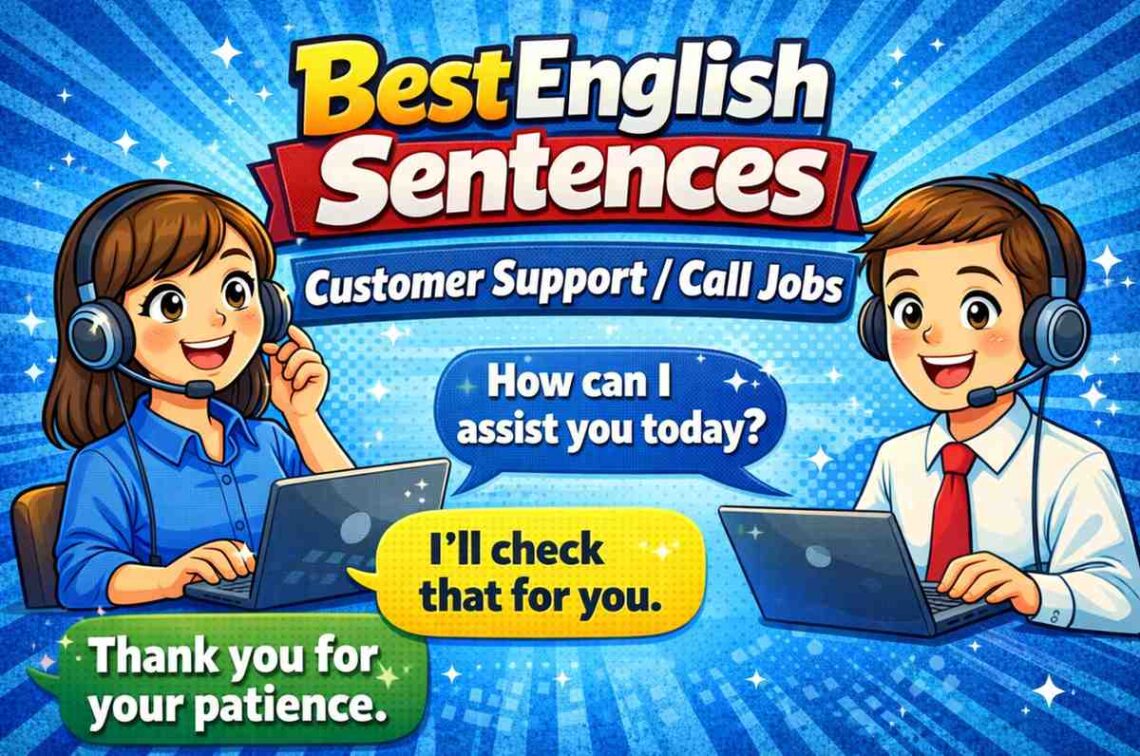
In this massive guide, we are going to break down the Best English Sentences for Customer Support. We will cover everything from the perfect greeting to handling the angriest customers with grace.

Why “Scripting” Isn’t Enough
Before we dive into the sentences, let’s talk about tone.
In the old days of call centers, agents read from a robotic script.
- Agent: “I apologize for the inconvenience.”
- Customer: “My house is on fire!”
- Agent: “I apologize for the inconvenience.”
That doesn’t work anymore. Modern customer service is about Empathy, Personalization, and Active Listening. The sentences below are templates—you should always adapt them to fit the specific situation and your company’s brand voice.
Phase 1: The Perfect Greeting (The First 10 Seconds)
The first 10 seconds determine the mood of the entire call. If you sound tired, bored, or unsure, the customer will immediately lose confidence in you.
Professional Openings
Instead of just saying “Hello,” try these professional variations:
- “Thank you for calling [Company Name], my name is [Name]. How may I assist you today?”
- Why it works: It’s classic, polite, and sets a helpful tone.
- “Good morning/afternoon! You’ve reached [Company Name], [Name] speaking. How can I help you?”
- Why it works: The time-of-day greeting adds a human touch.
- “Hi, thanks for reaching out to [Company Name]. I’m [Name], and I’m here to help. What’s going on?”
- Why it works: This is better for “cool” or tech-savvy brands (like startups) where a casual tone is preferred.
Asking for the Customer’s Name
Once they state their problem, you need to establish a connection.
- “I’d be happy to help you with that. May I have your name, please?”
- “I can certainly check that for you. Who am I speaking with?”
- “Nice to meet you, [Name]. How are you doing today?”
- Note: Only ask “how are you” if the customer sounds calm. If they are angry, skip the small talk and get to work.
Phase 2: Acknowledging the Issue & Empathy
This is the most critical part of the call. Before you fix the problem, you must validate the customer’s feelings. If you skip this, you seem robotic.
When the Customer is Frustrated
- “I completely understand why that would be frustrating.”
- “I can see how annoying that must be for you.”
- “That definitely sounds stressful. Let’s see what we can do to fix it right now.”
- “I appreciate you bringing this to our attention.”
When You Need to Apologize
There is a difference between admitting fault and showing empathy.
- Empathy: “I am sorry you are dealing with this.” (You regret the situation).
- Responsibility: “I am sorry we made a mistake.” (The company messed up).
- “Please accept my sincere apologies for the trouble.”
- “I am so sorry for the mix-up/confusion.”
- “I know this hasn’t been the experience you expected from us, and I apologize for that.”
- “I realize how urgent this is, and I want to get this resolved for you immediately.”
Phase 3: Gathering Information (Active Listening)
You need details to solve the problem, but interrogating the customer can feel rude. Use “softeners” to ask questions gently.
Investigating the Problem
- “Do you mind if I ask a few quick questions to better understand the situation?”
- “Just to make sure I’m on the same page, could you clarify…”
- “Could you please walk me through what happened right before the error appeared?”
- “May I have your account number so I can pull up your details?”
Confirming You Understood
Always paraphrase what the customer said. This is called “Mirroring.”
- “So, if I understand correctly, you are seeing an error code 404 when you try to log in?”
- “Just to recap: you were charged twice for the same subscription, correct?”
- “Let me make sure I have this right…”
Phase 4: Putting the Customer on Hold
Nobody likes hold music. If you have to put them on hold, you must ask for permission and explain why.
Asking for Permission
- “May I place you on a brief hold while I check the details with my supervisor?”
- “I need to run a quick diagnostic test. Would it be okay if I put you on hold for about two minutes?”
- “To get the right information, I need to check our database. Do you mind holding for a moment?”
Getting Back on the Line
Never just say “Hello?” when you return.
- “Thank you so much for your patience. I have those details for you now.”
- “Thanks for holding. I appreciate you waiting.”
- “I have looked into the account, and here is what I found…”
Phase 5: Troubleshooting & Giving Instructions
When explaining technical steps, simple English is best. Avoid jargon.
- “Please bear with me while I walk you through the steps.”
- “For the next step, I need you to…”
- “Are you able to see the ‘Settings’ icon on your screen?”
- “Let’s try this together. First, please click on…”
- “Take your time, there is no rush.” (Great for elderly or non-tech-savvy customers).
Phase 6: Delivering Bad News (The Art of “No”)
Sometimes, you cannot give the customer what they want. The key is to use Positive Positioning. Instead of saying what you can’t do, say what you can do.
Replacing “No”
- Bad: “We can’t do that.”
- Good: “While I can’t offer a full refund, what I can do is offer you a credit for next month.”
- “Although that specific feature isn’t available right now, here is a workaround that might help.”
- “I wish I could approve that for you, but our policy requires…”
- “That isn’t something we can do directly, but here is the best alternative.”
- “I understand you are looking for a refund. While the purchase is non-refundable, I can offer you a 20% discount code for future use.”
Phase 7: Handling Angry Customers (De-escalation)
This is the hardest part of the job. When a customer is shouting, your goal is to lower the temperature.
The “HEAT” Method Scripts
- Hear them out: (Don’t interrupt).
- Empathize: (Use the scripts from Phase 2).
- Apologize: (Take ownership).
- Take Action: (Fix it).
- “I can hear that you are very upset, and I want you to know I am going to do my best to help you.”
- “You are right to be annoyed. That sounds incredibly frustrating.”
- “I completely understand where you are coming from.”
- “Let’s focus on finding a solution for this right now.”
- “I’m going to take personal responsibility for this issue.”
Important: Never tell an angry customer to “Calm down.” It always makes them angrier. Instead, lower your own volume and speak slower.
Phase 8: Closing the Call
The “Last Impression” is just as important as the first. You want the customer to leave feeling supported.
Checking for Further Issues
- “Is there anything else I can help you with today?”
- “Have I answered all your questions?”
- “I want to make sure you’re all set. Do you need help with anything else?”
The Final Sign-off
- “Thank you for calling [Company]. I hope you have a wonderful day!”
- “Thanks for being a loyal customer. Enjoy your weekend!”
- “If any other issues come up, please don’t hesitate to call us back.”
- “Thanks for choosing [Company]. Take care!”
🚫 The “Forbidden Phrases” List (And What to Say Instead)
Using negative language triggers defensiveness in customers. Swap these out immediately.
| Don’t Say This | Say This Instead | Why? |
| “I don’t know.” | “Let me find that out for you.” | Shows you are proactive. |
| “Calm down.” | “I understand why you are upset.” | Validates feelings. |
| “It’s not my fault.” | “Let’s see how we can fix this.” | Focuses on solution, not blame. |
| “You need to…” | “Could you please…” | Sounds polite, not bossy. |
| “Hold on.” | “May I place you on a brief hold?” | Respects their time. |
| “That’s against policy.” | “Due to security protocols, we can’t…” | “Protocol” sounds more professional than “Policy.” |
Bonus: Email & Chat Support Templates
Writing is different from speaking. In chat support, you need to be concise.
For Live Chat:
- “Hi [Name]! Thanks for chatting in. Give me just a moment to read your query.”
- “I’m looking into that for you now. One moment, please.”
- “Are you still with me?” (If they stop replying).
For Email:
- “Thank you for bringing this to our attention.”
- “I have attached a guide that explains the process in detail.”
- “We look forward to resolving this for you.”
Tips for Non-Native English Speakers
If English isn’t your first language, you might worry about your accent or grammar. Here is the truth: Confidence and Clarity beat “Perfect” English.
- Keep it Simple: You don’t need fancy vocabulary. Simple, direct sentences are easier to understand over a bad phone line.
- Slow Down: When we get nervous, we speak fast. Speaking slowly makes you sound more authoritative and calm.
- Use “Signposting”: Tell the customer what you are doing.
- “First, I will check your account.”
- “Then, I will process the refund.”
- “Finally, I will send you a confirmation email.”
Conclusion: It’s About the Feeling
The best customer support agents aren’t human dictionaries. They are problem solvers with heart.
The sentences in this guide are tools. Like a carpenter’s hammer, they only work if you use them with skill. Listen to your customer. If they are joking, you can joke. If they are serious, be serious. Match their energy, use these scripts to guide the conversation, and you will find that even difficult calls become manageable.
Do you have a tough customer situation you don’t know how to handle? Leave a comment below, and I’ll write a script for you!
❓ Frequently Asked Questions (FAQ)
Q: What if I don’t know the answer? A: Never lie. Say, “That’s a great question. I want to be 100% sure before I answer, so let me double-check that with our specialist.”
Q: How do I handle a rude customer? A: Don’t take it personally. They are mad at the situation, not you. Stick to the facts, be polite but firm, and focus on the solution.
Q: What is the most important soft skill in BPO? A: Active Listening. Most mistakes happen because the agent assumed they knew the problem before the customer finished talking.

Suman
I am the creator of SpeakEdge, a learning-focused blog dedicated to English speaking, career guidance, and self-improvement. My goal is to help students, job seekers, and beginners improve their communication skills, gain confidence, and make better career decisions through simple, practical, and easy-to-understand content. I believe learning should be clear, honest, and useful in real life—not confusing or overwhelming.





2 Comments
Pingback:
Pingback: