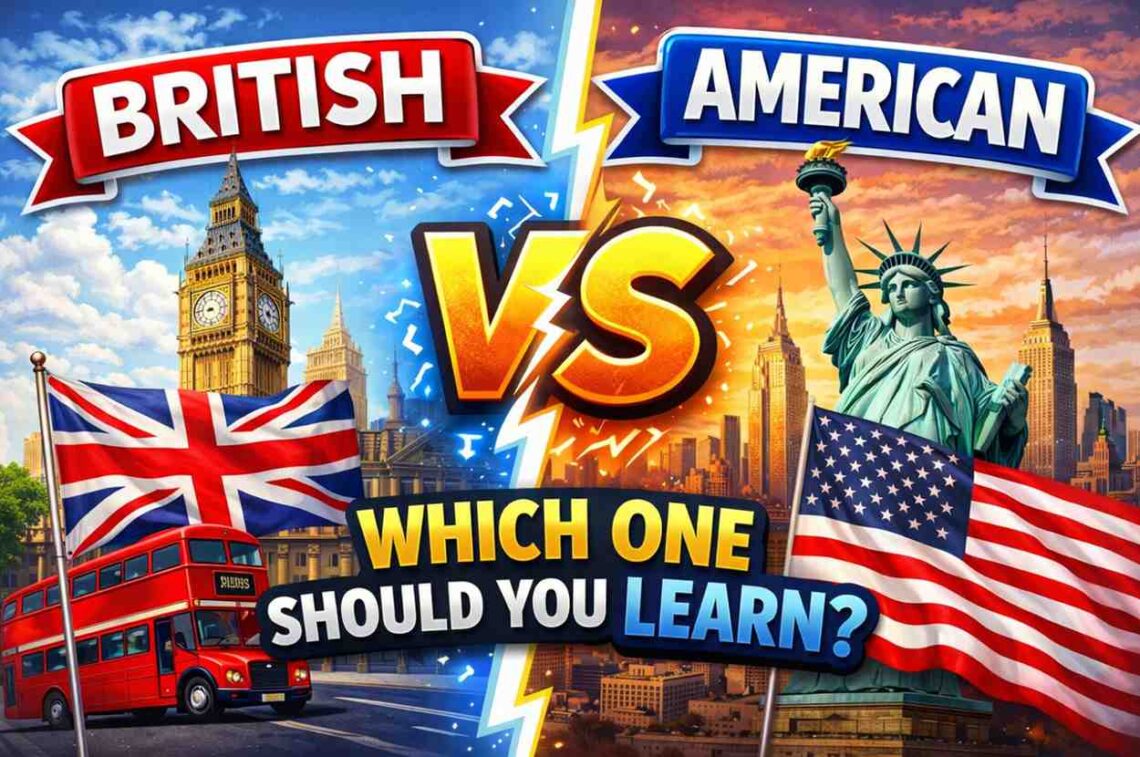
British vs. American English: Which One Should You Learn?
It’s the classic linguistic showdown. You’re ready to take your English to the next level, but you hit a fork in the road. One sign points to “London” with its crisp pronunciation and historic charm. The other points to “New York” with its Hollywood familiarity and global business reach.
If you are an English learner, you’ve likely asked yourself: “Should I learn British or American English?”
The short answer? There is no “wrong” choice. Both are standard, correct, and mutually intelligible. However, depending on your career goals, where you want to live, or simply which movies you prefer, one might be a slightly better fit for you than the other.
In this guide, we’ll break down the key differences, the pros of each, and help you decide which version of English deserves your focus.
The Core Differences: More Than Just an Accent
While a native speaker from London can easily understand a native speaker from Los Angeles, there are distinct differences that can trip up a learner.
1. Vocabulary: The “Chips” vs. “Fries” Dilemma
This is often the most fun—and confusing—part of learning the differences. You might think you know what “pants” are, but the meaning changes entirely depending on which side of the Atlantic you are on!
| Concept | American English (AmE) | British English (BrE) |
| Footwear | Sneakers | Trainers |
| Clothing | Pants | Trousers |
| Clothing | Sweater | Jumper |
| Food | French Fries | Chips |
| Food | Chips | Crisps |
| Food | Cookie | Biscuit |
| Car part | Hood | Bonnet |
| Car part | Trunk | Boot |
| Building | Apartment | Flat |
| Travel | Vacation | Holiday |
2. Spelling: The Case of the Missing “U”
American spelling was largely influenced by Noah Webster (of Webster’s Dictionary fame), who wanted to simplify the language. British English tends to keep the spellings derived from French or Latin.
- -or vs. -our: Color/Colour, Honor/Honour, Flavor/Flavour.
- -er vs. -re: Center/Centre, Theater/Theatre, Meter/Metre.
- -ize vs. -ise: Realize/Realise, Organize/Organise (Note: Oxford spelling often uses -ize, but -ise is the standard British preference today).
- -se vs. -ce: Defense/Defence, License/Licence (noun).
3. Grammar: Have You Got It?
While grammar is 95% the same, subtle differences exist.
- Present Perfect: Americans often use the past simple for recent events (“I ate already”), whereas Brits prefer the present perfect (“I have eaten already”).
- Possession: Americans usually say “I have a car,” while Brits often say “I have got a car.”
- Collective Nouns: In American English, collective nouns are singular (“The team is winning”). In British English, they can be plural depending on context (“The team are winning”).
The Case for American English (AmE)
Why is American English the most popular choice for learners globally?
1. Pop Culture Dominance Hollywood movies, Netflix series, pop music, and YouTube are overwhelmingly dominated by American creators. Because of this, you are likely already “studying” American English every time you watch Friends or listen to Taylor Swift. This makes finding study materials incredibly easy and fun.
2. The Tech and Business Standard If you work in technology, startups, or international digital marketing, American English is often the default. Silicon Valley terminology (and spelling) dominates the web.
3. Often Simpler to Pronounce This is subjective, but many learners find the “rhotic” American accent (where you pronounce the ‘r’ in words like hard or car) easier to mimic than the non-rhotic British accent.
Choose American English if:
- You plan to work in the US, Canada, or for an American multinational company.
- You enjoy American entertainment and want to understand it without subtitles.
- You want the most widely recognized accent in international tourism.
The Case for British English (BrE)
British English carries a weight of history and prestige that is hard to beat.
1. Academic Prestige If you plan to take the IELTS exam or study at universities in the UK, Ireland, Australia, or New Zealand, British English is the standard. It is often viewed as the “traditional” and “proper” form of the language in academic circles.
2. The Commonwealth Connection British English isn’t just for the UK. It is the basis for the English spoken in Australia, New Zealand, South Africa, India, Singapore, and Hong Kong. If you are traveling or doing business in these regions, British spelling and vocabulary will serve you better.
3. Precision and Clarity Many learners appreciate the distinctness of Received Pronunciation (RP)—the “Queen’s English.” It is often taught in European schools and is associated with clarity and diplomacy.
Choose British English if:
- You are targeting the IELTS exam (though they accept American English, the materials are British-centric).
- You want to work or study in the UK, Europe, or Commonwealth nations.
- You prefer the aesthetic and “sound” of British accents.
The Golden Rule: Consistency is Key
Here is the most important tip for passing exams (like TOEFL or IELTS) and writing professionally: Pick one and stick to it.
It generally doesn’t matter if you write “colour” or “color.” What matters is that you don’t write “colour” in the first paragraph and “color” in the second. Mixing the two can look messy and unprofessional.
Pro Tip: Set your spell-check to either “English (US)” or “English (UK)” to help you maintain consistency in your writing.
Final Verdict: Which Should You Choose?
If you are still on the fence, look at your environment.
- Living in Europe? British English is likely more useful.
- Living in Latin America or East Asia? American English is usually the standard.
- Just want to communicate? Don’t stress! A mix (often called “Mid-Atlantic” or “International English”) is perfectly acceptable in casual conversation.
Ultimately, the “best” English is the one you enjoy learning. If you love Harry Potter, go British. If you love The Avengers, go American. Motivation is the biggest factor in language learning success, so follow your interests.
Frequently Asked Questions (FAQ)
Q: Can Americans understand British people? A: Yes, absolutely. Aside from a few slang words, they understand each other perfectly.
Q: Which is harder to learn? A: Neither is objectively harder. American pronunciation can be more relaxed (lots of “gonna” and “wanna”), while British English has more complex vowel sounds. It depends on your native language.
Q: Does it matter for AdSense or SEO? A: For blogging, consistency is key for SEO, but Google understands that “optimize” and “optimise” are the same word. Write for your specific audience location.
Start Your Journey Today
Don’t let the choice paralyze you. Start with the version that feels most natural to you today. You can always learn the differences later—in fact, most advanced speakers eventually become “bidialectal” and can switch between the two!
💼 Bonus: Business English Cheat Sheet
If you are learning English for your career, knowing the difference between US and UK terminology is crucial to avoid confusion in meetings.
| Meaning | American English (US) | British English (UK) |
| The list of items to discuss | Agenda / Schedule | Agenda |
| A written record of a meeting | Minutes | Minutes |
| Time off work | Vacation Time | Holiday Entitlement |
| A rise in salary | Raise | Pay rise |
| A document covering your career | Resume | CV (Curriculum Vitae) |
| The ground floor | First Floor | Ground Floor |
| The period before an election | Campaign trail | Canvassing |
| To put in the trash | To trash / toss | To bin |
| End of the work day | Quitting time | Knocking off time |
🧠 Test Yourself: Are You Speaking American or British?
Cover the right side of the screen and see if you can guess the equivalent word!
1. You need to get to the top floor of a building. Do you take the…
- 🇺🇸 Elevator
- 🇬🇧 Lift
2. You are hungry and want a snack made of sliced potatoes. You eat…
- 🇺🇸 Chips
- 🇬🇧 Crisps
3. It’s raining and you need to walk outside. You walk on the…
- 🇺🇸 Sidewalk
- 🇬🇧 Pavement
4. You need to fill up your car with fuel. You go to the…
- 🇺🇸 Gas Station
- 🇬🇧 Petrol Station
5. You are going to watch a movie. You go to the…
- 🇺🇸 Movie Theater
- 🇬🇧 Cinema
Thanks for reading!
I hope this guide helped clear up the confusion between British and American English. Now I’d love to hear from you: Which version are you currently learning? Do you prefer the sound of a London accent or the familiarity of New York slang?
Drop a comment below and let’s chat!

Suman
I am the creator of SpeakEdge, a learning-focused blog dedicated to English speaking, career guidance, and self-improvement. My goal is to help students, job seekers, and beginners improve their communication skills, gain confidence, and make better career decisions through simple, practical, and easy-to-understand content. I believe learning should be clear, honest, and useful in real life—not confusing or overwhelming.