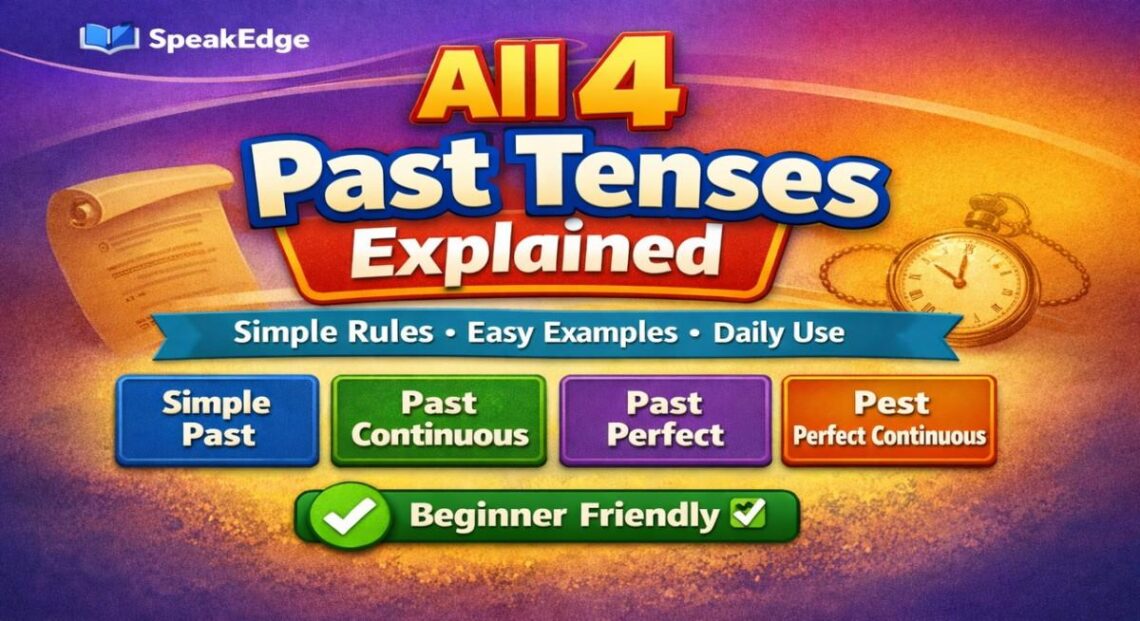
The Complete Guide to the 4 Past Tenses (Finally Explained Simply)
Have you ever told a story and suddenly felt stuck? You want to say what happened, but you aren’t sure if you “had been walking,” “was walking,” or just “walked.”
English grammar is tricky, especially when talking about the past. Unlike some languages that just have one way to say “it happened,” English gives us four different ways to describe history.
Why? Because English cares about the details. Did it happen quickly? Did it go on for a long time? Did it happen before something else?
In this guide, we are going to master the Past Tense. No confusing jargon—just clear rules and examples you can actually use.
1. Simple Past Tense
“The History Book Tense”
This is the most common way to talk about the past. If you want to state a fact that is over, finished, and done with, this is your go-to tense. The key here is that the action is completed.
When to use it:
- Completed Actions: Things that started and finished in the past.
- Specific Times: When you know exactly when it happened (yesterday, in 1999, last week).
- Series of Events: “I woke up, brushed my teeth, and left.”
The Formula:
Subject + Verb-ed (or irregular verb)
Real-Life Examples:
- I watched a movie yesterday. (The movie is over).
- She bought a new car last month. (One-time action).
- We lived in London for five years. (We don’t live there anymore).
- He didn’t go to the party. (Negative form).
2. Past Continuous Tense
“The Storytelling Tense”
This tense sets the scene. It describes an action that was in progress at a specific moment in the past. We often use it to show that something was happening when it was suddenly interrupted.
When to use it:
- Interrupted Actions: “I was cooking when the phone rang.”
- Parallel Actions: Two things happening at the same time in the past.
- Atmosphere: Describing the background of a story (The sun was shining, birds were singing…).
The Formula:
Subject + was/were + Verb(-ing)
Real-Life Examples:
- I was sleeping when you called. (You interrupted my sleep!).
- They were arguing all night. (It continued for a duration).
- While I was studying, my brother was playing video games. (Two actions at the same time).
- It was raining heavily when I left the house.
3. Past Perfect Tense
“The Past of the Past”
This is the tense that confuses people, but it is actually a life-saver for storytellers. Imagine you have two events in the past. You need to show which one happened first. The Past Perfect is for the event that happened earlier.
When to use it:
- Timeline Clarity: To show Action A happened before Action B.
- Regrets or Explanations: “If I had known…”
The Formula:
Subject + had + Past Participle (V3)
Real-Life Examples:
- When I arrived at the station, the train had left. (The train left before I arrived).
- She was hungry because she had not eaten all day. (The not-eating happened before the being hungry).
- I realized that I had met him before.
- The movie had already started by the time we got our popcorn.
4. Past Perfect Continuous Tense
“The Marathon Tense (Past Version)”
Just like the Present Perfect Continuous, this one is all about duration. It shows that something started in the past and continued up until another point in the past. It emphasizes how long or how hard the activity was.
When to use it:
- Duration before something else: Showing how long an action happened before it stopped.
- Cause and Effect: Explaining why something happened in the past based on a long activity.
The Formula:
Subject + had + been + Verb(-ing)
Real-Life Examples:
- I had been waiting for 30 minutes when the bus finally came. (Focus on the waiting time).
- The road was wet because it had been raining. (The rain stopped, but we see the result).
- She was tired because she had been running.
- They had been dating for five years before they got married.
Cheat Sheet: The “Pizza” Analogy
To make it easy, let’s look at how the meaning changes with a simple sentence about eating pizza.
- Simple Past:I ate the pizza.
- (The pizza is gone. I finished it.)
- Past Continuous:I was eating the pizza.
- (I was in the middle of eating it—maybe you interrupted me?)
- Past Perfect:I had eaten the pizza.
- (I ate it before you arrived or asked for a slice. Too late!)
- Past Perfect Continuous:I had been eating pizza.
- (I was eating it for a while before I got full/stopped. Focus is on the process).
Conclusion
Don’t let the fancy names scare you. The best way to learn these tenses is to listen to how people tell stories. Notice how they switch from “I walked in” (Simple) to “Everyone was dancing” (Continuous).
Start practicing today by writing a short paragraph about what you did yesterday. Try to use at least three of these tenses!

Suman
I am the creator of SpeakEdge, a learning-focused blog dedicated to English speaking, career guidance, and self-improvement. My goal is to help students, job seekers, and beginners improve their communication skills, gain confidence, and make better career decisions through simple, practical, and easy-to-understand content. I believe learning should be clear, honest, and useful in real life—not confusing or overwhelming.