
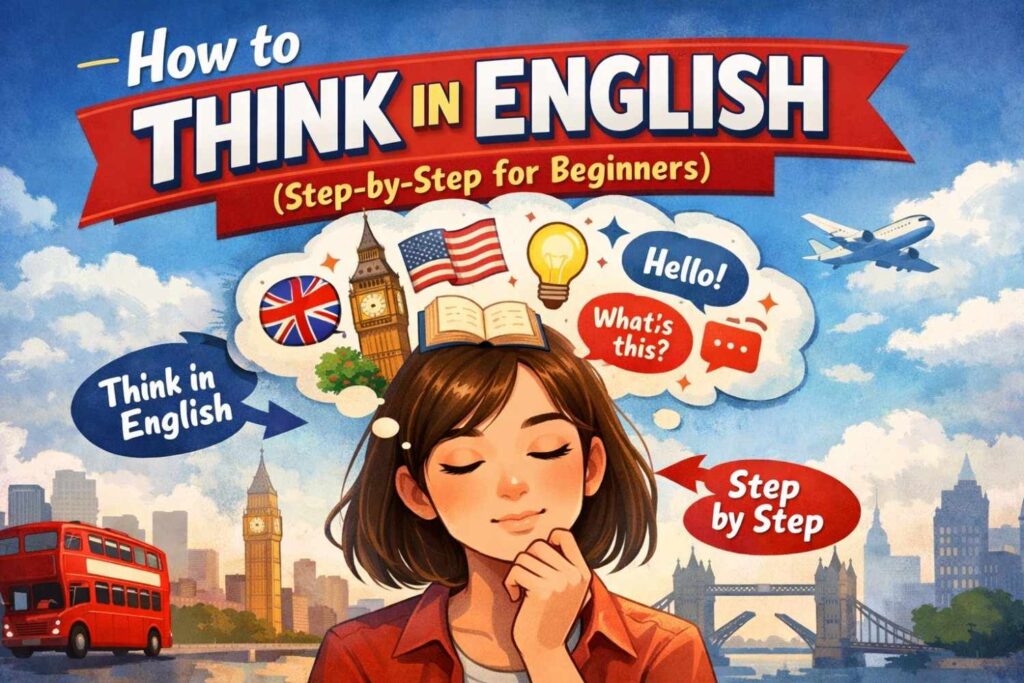
The Ultimate Guide: How to Think in English (Step-by-Step for Beginners)
Have you ever found yourself in the middle of a conversation in English, pausing awkwardly while your brain frantically searches for the right word? You know the word in your native language. You can almost see it. But by the time you translate it into English, the conversation has moved on, and you’re left nodding silently.
This is the “Translation Trap.”
If you are reading this, you probably already know vocabulary. You know grammar rules. You might even be able to write well. But when it comes to speaking fluently, you feel stuck because you are still translating everything in your head.
Here is the truth: Fluency isn’t about knowing more words; it’s about removing the middleman.
To speak English fluently, you must stop translating and start thinking in English. It sounds impossible, right? Like a magic trick that only advanced speakers can do. But it isn’t magic. It is a habit. And like any habit, it can be built step-by-step.
In this guide, we are going to break down exactly how to rewire your brain to think directly in English. No complex grammar drills—just practical, daily exercises that will change the way you process language.
Why You Struggle to Think in English (It’s Not Your Fault)
Before we fix the problem, we need to understand it. Why is it so hard to switch your internal monologue to a new language?
When you first learned English, you were likely taught using translation. Your teacher said “Apple,” and you immediately thought of the word for apple in your native language (“Manzana,” “Pomme,” “Ringo,” etc.).
This created a neural pathway where English is always routed through your mother tongue.
- The Old Path: object → Native Language Word → English Word.
- The Goal Path: object → English Word.
The “Old Path” is slow. It requires double the cognitive energy. When you are tired or nervous, your brain defaults to the path of least resistance—your native language. To change this, we don’t need to erase your native language; we just need to build a new, faster highway for English.
The Golden Rule: Start Small, Don’t Stress
The biggest mistake learners make is trying to have deep philosophical thoughts in English on Day 1. That is a recipe for burnout.
You cannot run a marathon if you haven’t learned to walk. We are going to start with the simplest level and slowly build up.
The “No-Pressure” Mantra: If you can’t find the English word, do not translate it. Instead, describe it, skip it, or use a simpler word. Do not let your brain revert to your native language.
Phase 1: The Naming Game (Level: Beginner)
This is the foundation. You can do this anywhere—on the bus, at your desk, or while making coffee. The goal is to associate physical objects directly with English words, bypassing translation.
Step 1: The “Post-It” Method
If you are at home, use visual cues. Buy a pack of sticky notes. Label everything in your room.
- Don’t just write “Door.” Write a short phrase: “The wooden door.”
- Put a note on your mirror: “Look at that smile!”
Every time you look at the object, read the English note. This forces your brain to visualize the object and the English word simultaneously.
Step 2: The 360-Degree Scan
Wherever you are right now, look around. Identify 5 objects. Name them in your head immediately.
- Table.
- Computer.
- Coffee.
- Blue pen.
- Window.
Did you hear your native language first? If yes, stop. Look at the object again. Take a deep breath. Say the English word. Do this until the English word is the first thing that pops up.
Step 3: Fast-Fire Counting
Challenge your brain speed. Give yourself 10 seconds to name 10 things you see. Speed prevents your brain from having the time to translate. It forces instinct.
Phase 2: Simple Sentences & Verbs (Level: Pre-Intermediate)
Once you can name objects, you need to add movement. Life isn’t a still image; it’s a movie. We need verbs.
Step 1: Narrate Your Actions
As you go about your day, become the narrator of your own documentary. Use simple Subject-Verb-Object sentences.
- I am opening the door.
- I am putting on my shoes.
- The bus is late.
- This coffee is hot.
Key Tip: Do not worry about complex tenses. “I am walking” is perfectly fine. You don’t need to worry about “I have been walking.” Just keep the flow moving.
Step 2: The “Because” Extension
Now, let’s make those sentences slightly longer to engage your logic centers. Add the word “because” to your narration.
- I am opening the window… because it is hot in here.
- I am drinking water… because I am thirsty.
- I am buying this shirt… because I like the color.
This forces you to think in connected thoughts rather than isolated words.
Phase 3: The Monolingual Switch (Level: Intermediate)
This is the most critical step in your journey. You must stop using a bilingual dictionary.
The Problem with Bilingual Dictionaries
When you see a new English word and look up the translation in your native language, you are reinforcing the “Old Path.” You are telling your brain, “English is just a code for my real language.”
The Solution: English-to-English Definitions
Use a learner’s dictionary (like Cambridge or Oxford Learner’s). These dictionaries explain complex words using simple English vocabulary.
Example:
- Word: Gigantic
- Bad habit: Translating to your native word for “very big.”
- New habit: Reading the definition: “Extremely big or huge.”
Now, you are learning English through English. You are building a web of connections entirely within the language.
Action Step: Change the default dictionary app on your phone today. Remove the translation app from your home screen and replace it with a Monolingual English dictionary.
Phase 4: Talking to Yourself (The “Crazy” Method)
It sounds strange, but talking to yourself is the most effective way to practice thinking in English without the fear of judgment. When you speak to others, you are nervous about making mistakes. When you speak to yourself, you are free.
Exercise 1: The Morning Plan
When you wake up, spend two minutes planning your day mentally in English.
- “Okay, first I need to brush my teeth. Then I’ll make toast. I have a meeting at 10 AM, so I need to leave by 9:30.”
Exercise 2: The Recap
Before you go to sleep, replay your day.
- “Today was tiring. I missed the bus, but the lunch was good. I spoke to Sarah about the project.”
Exercise 3: Emotional Check-ins
This is advanced but powerful. When you feel a strong emotion, try to label it and explain it in English.
- “I am feeling anxious. Why? Because I have a deadline coming up.”
- “I am so happy right now because the sun is shining.”
Connecting emotions to English helps the language penetrate the deeper parts of your brain.
Phase 5: Immersion at Home (The “English Bubble”)
You don’t need to live in New York or London to immerse yourself. You can create an “English Bubble” in your bedroom.
Change Your Digital Environment
We spend hours on our phones. Turn that time into practice.
- Change your phone language settings to English. You know where the icons are; you won’t get lost. But seeing “Settings,” “Display,” and “Notifications” daily burns those words into your brain.
- Social Media Detox. Follow 5 new accounts that speak only in English about your hobbies. If you love cooking, follow English chefs. If you love coding, follow tech YouTubers.
- The “No Subtitles” Rule. When watching Netflix, turn off the subtitles in your native language. If you must use subtitles, use English subtitles. This connects the sound of the word to the spelling.
Phase 6: Dealing with “Brain Block”
Even with all these exercises, you will have moments where your brain freezes. You simply cannot find the word.
Do NOT pull out your phone to translate.
Instead, use Circumlocution. This is the art of describing a word you don’t know using words you do know.
- Scenario: You forget the word for “Garage.”
- Don’t say: [Native word]
- Say: “The place where you park your car at your house.”
- Scenario: You forget the word for “Umbrella.”
- Say: “The thing you hold over your head when it rains.”
This is actually how native speakers think! We forget words all the time. We don’t stop talking; we describe what we mean. If you can master this, you will never be silent again.
Advanced Strategy: The Prediction Game
This is for those who are ready to take it to the next level. When you are listening to a podcast or watching a YouTube video in English, press pause in the middle of a sentence.
Try to complete the sentence.
- Audio: “The weather today is going to be…”
- You (Thinking): “…sunny?” “…terrible?” “…rainy?”
Then play the video. Were you right? This forces your brain to predict English patterns. It trains your intuition. Eventually, you won’t need to think about grammar rules; you will just “feel” what the next word should be.
A Note on Perfectionism: The Enemy of Fluency
Why do we translate? Usually, it is because we want to be precise. We want to sound as smart in English as we do in our native language.
When you translate, you are trying to move a complex idea from Language A to Language B perfectly. But languages are different. They have different structures and idioms. Direct translation often sounds unnatural.
Accept that your English personality will be simpler at first. You might feel like a child. You might use simple words like “good” instead of “exquisite.” That is okay.
It is better to speak simple, fluent English than complex, broken English.
- Simple & Fluent: “I was very hungry, so I ate a burger.” (Good!)
- Complex & Translated: “I possessed a ravenous appetite, therefore I consumed a…” (Brain freeze).
Let go of perfection. Embrace communication.
Summary: Your 7-Day Challenge
Reading this blog post won’t change your brain. Action will.
Here is your homework for the next 7 days. If you do this, you will see a difference.
- Day 1: Change your phone language to English.
- Day 2: Name 5 objects in every room you enter.
- Day 3: Narrate your morning routine (Subject + Verb).
- Day 4: Switch to a Monolingual Dictionary.
- Day 5: Practice “Circumlocution” (describe 3 objects without naming them).
- Day 6: Talk to yourself for 5 minutes while walking or driving.
- Day 7: Think about your feelings in English.
Frequently Asked Questions (FAQ)
Q: How long does it take to start thinking in English? A: It varies. If you practice daily, you will notice small changes in 2-3 weeks. For complete comfort, it can take months of consistency. It’s a marathon, not a sprint.
Q: My vocabulary is very small. Can I still do this? A: Yes! In fact, it’s easier to start when you are a beginner. Start with the words you know. If you only know “cat” and “run,” think “The cat runs.” Do not wait until you are “advanced.”
Q: I get a headache when I try to think in English. Is that normal? A: Absolutely. That is “cognitive load.” It means your brain is working out, just like a muscle at the gym. If you get tired, take a break. It gets easier with time.
Q: Should I force myself to think in English 24/7? A: No. That is impossible and exhausting. Set specific “English Time” blocks (e.g., 10 minutes in the morning, 10 minutes at lunch).
Final Thoughts
Thinking in English is the key that unlocks the door to fluency. It stops the hesitation, kills the anxiety, and allows your true personality to shine through in a new language.
Remember, every time you resist the urge to translate, you are laying a brick in the foundation of your fluency. Be patient with yourself. You are doing something incredible—teaching your brain a whole new way to see the world.

Suman
I am the creator of SpeakEdge, a learning-focused blog dedicated to English speaking, career guidance, and self-improvement. My goal is to help students, job seekers, and beginners improve their communication skills, gain confidence, and make better career decisions through simple, practical, and easy-to-understand content. I believe learning should be clear, honest, and useful in real life—not confusing or overwhelming.





2 Comments
Pingback:
Pingback: