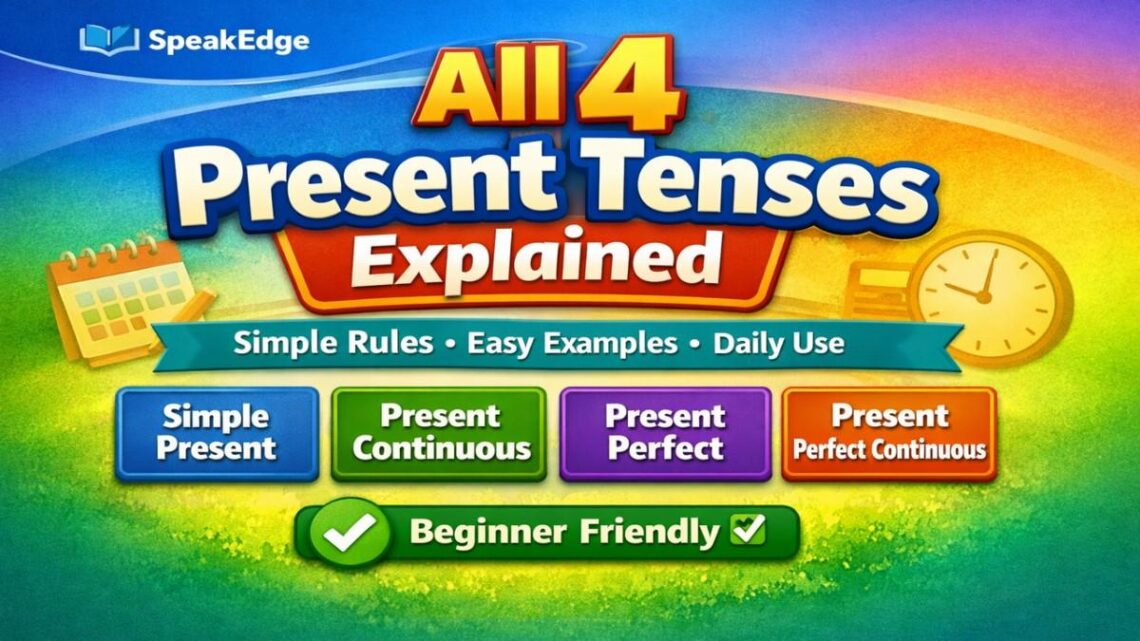
The Ultimate Guide to the 4 Present Tenses (With Examples That Actually Make Sense)
Let’s be honest: English grammar can sometimes feel like trying to solve a puzzle where the pieces keep changing shape. You think you know how to talk about “now,” and then suddenly you’re hit with terms like “Perfect Continuous.”
But here is the secret: Tenses aren’t just rules to memorize; they are tools to help you tell your story more precisely. Whether you are describing a daily habit, something happening right this second, or an experience you’ve had, the Present Tense has a specific “flavor” for it.
In this guide, we are going to break down all four types of Present Tense. No boring textbook jargon—just clear explanations and examples you can actually use.
1. Simple Present Tense
“The Daily Routine Tense”
Think of the Simple Present tense as your default setting. We use this for things that are generally true, happen regularly, or are permanent facts. It’s not necessarily about what is happening literally right now, but rather what happens in your life in general.
When to use it:
- Habits & Routines: Things you do every day, week, or year.
- General Facts: Truths that don’t change (like the sun rising).
- Scheduled Events: Timetables (buses, flights).
The Formula:
Subject + Base Verb (+ s/es for He/She/It)
Real-Life Examples:
- I drink coffee every morning. (This is my habit).
- She works at a software company. (This is a permanent situation).
- The train leaves at 9:00 PM. (This is a schedule).
- Water boils at 100 degrees Celsius. (This is a fact).
2. Present Continuous Tense
“The Right-Now Tense”
Also known as the Present Progressive, this tense is all about action. It describes something that is happening at this very moment or a temporary situation that is currently unfolding. If you can see it happening with your eyes, you probably need this tense.
When to use it:
- Actions happening now: You are doing it as you speak.
- Temporary situations: Something true for a short time, but not forever.
- Future plans: Definite arrangements in the near future.
The Formula:
Subject + am/is/are + Verb(-ing)
Real-Life Examples:
- I am reading a blog post right now. (Happening this second).
- They are playing football in the park. (You can see them doing it).
- She is staying with her cousin for a week. (Temporary situation).
- We are meeting for lunch tomorrow. (A planned arrangement).
3. Present Perfect Tense
“The Bridge Tense”
This is the one that trips people up, but it’s actually very poetic. The Present Perfect connects the past to the present. It describes something that happened in the past but is still important or relevant now. It cares about the result, not the specific time it happened.
When to use it:
- Life Experiences: Things you have done (time doesn’t matter).
- Unfinished Time: Actions in a time period that isn’t over yet (today, this week).
- Recent Actions: Things that just happened and have a result now.
The Formula:
Subject + have/has + Past Participle (V3)
Real-Life Examples:
- I have visited Paris three times. (My life experience).
- She has lost her keys. (Result: She doesn’t have them now).
- We have finished the project. (It is done, and we are ready for the next step).
- He has not eaten lunch yet. (Implies he might eat soon).
4. Present Perfect Continuous Tense
“The Marathon Tense”
If the Present Perfect is about the result, the Present Perfect Continuous is about the process. It emphasizes the duration of an activity. It tells us that something started in the past and is still happening right now (or just recently stopped).
When to use it:
- Actions continuing from the past: Started earlier, still going on.
- Emphasizing duration: How long something has been happening.
- Visible side effects: You can see the evidence of the recent activity.
The Formula:
Subject + have/has + been + Verb(-ing)
Real-Life Examples:
- I have been waiting for you for two hours! (Started 2 hours ago, still waiting now).
- She has been learning English since 2020. (She is still learning today).
- It has been raining all day. (The ground is wet, and it might still be raining).
- You look tired. Have you been working out? (Visible effect of a recent action).
Quick Comparison Table
| Tense | Focus | Key Words | Example |
| Simple Present | Facts & Habits | Always, Usually, Every day | I work here. |
| Present Continuous | Action Right Now | Now, At the moment, Look! | I am working now. |
| Present Perfect | Result & Experience | Just, Yet, Already, Since | I have worked here before. |
| Present Perf. Cont. | Duration & Process | For, Since, All day | I have been working all day. |
Conclusion
Mastering these four tenses is the key to sounding natural in English. Instead of memorizing charts, try to think about the situation:
- Is it a habit? (Simple)
- Is it happening now? (Continuous)
- Is the result important? (Perfect)
- Has it been going on for a while? (Perfect Continuous)
Start practicing by narrating your day using these tenses. You’ll be surprised how quickly they become second nature!

Suman
I am the creator of SpeakEdge, a learning-focused blog dedicated to English speaking, career guidance, and self-improvement. My goal is to help students, job seekers, and beginners improve their communication skills, gain confidence, and make better career decisions through simple, practical, and easy-to-understand content. I believe learning should be clear, honest, and useful in real life—not confusing or overwhelming.


You May Also Like
The Ultimate Guide to the 4 Future Tenses (Predicting Tomorrow)

How to Build Your English Vocabulary Fast: 5 Proven Secrets